When selecting a fleece jacket for fall/winter commutes, the real issue isn't "which one looks most like the real thing," but whether the product page provides enough information for you to judge if it can handle warmth, layering, wind resistance, and daily maintenance during your commute. This article focuses on how to verify product information on fashionreps, helping you distinguish between known specs, pending information, and performance that cannot be directly inferred before ordering.
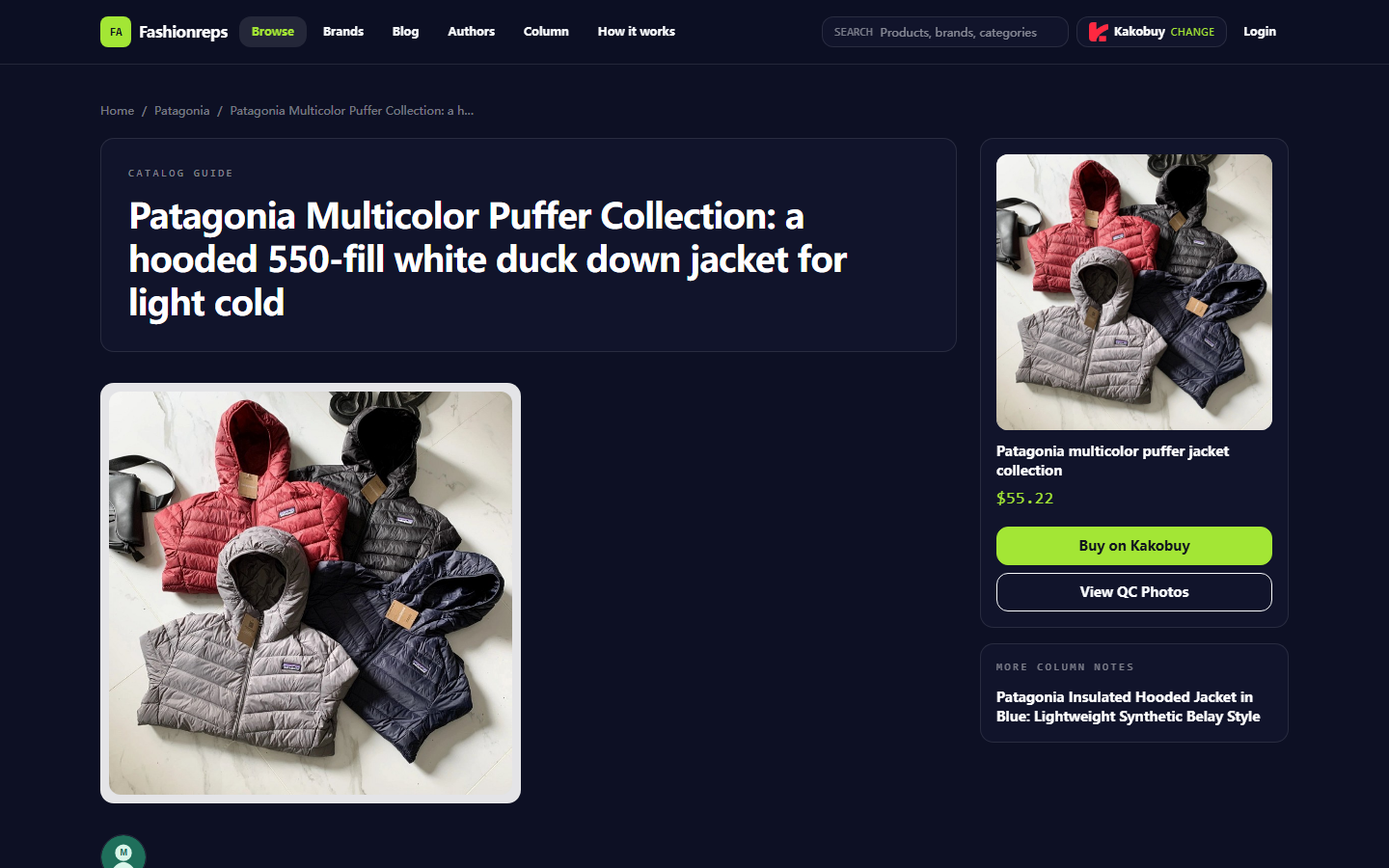
The verification date for this article is October 13, 2026. In the currently visible sample, the page mainly shows a Patagonia down jacket listing, not a confirmed fleece jacket. Therefore, this sample is better used as a reference for "how to identify information gaps," rather than directly proving the fabric, warmth, or wind resistance of a specific fleece jacket. 🧥

Image: Example of a Patagonia jacket listing in the fashionreps catalog. The visible information includes fill, fit, size, color, and purchase entry, but should not be taken as actual evidence for a fleece jacket.
Defining Commute Scenarios and Evaluation Scope
Here, "fall/winter commute" refers to the repeated transitions between city walking, public transportation, short outdoor stops, and indoor office environments. It is usually not equivalent to prolonged low-temperature outdoor activities or extended rain and snow exposure.
Before choosing a fleece jacket, clarify the main problem you need to solve:
- Do you need a mid-layer that works both indoors and outdoors, or one that must serve as the outer wind-resistant layer on its own?
- Does your commute involve long walks, cycling, or waiting on platforms?
- Do you frequently move between heated offices, malls, or train cars?
- Do you need to layer a lightweight down jacket, insulated jacket, or waterproof shell over the fleece?
- Do you prioritize lightweight, warmth, durability, quick-drying, or appearance and styling flexibility?
A common misconception is equating "fleece" with "suitable for winter." Fleece is typically better as an insulating mid-layer, but ultimate comfort depends on pile thickness, fabric density, fit, collar, cuffs, outer wind-blocking ability, and actual activity level. If a product page only says "fleece" without weight, construction, or detail photos, you cannot infer a specific warmth level.
Reading Visible Specs and Images on the Product Page
First, break down the page information into verifiable fields, rather than taking marketing descriptions as conclusions. For a fleece jacket for commuting, at least look for the following:
- Does the product name clearly include fleece, polar fleece, sherpa, microfleece, or another specific fabric description?
- Does it state the fabric composition, such as polyester or blend percentages?
- Does it explain the pile structure, thickness, weight, or inner construction?
- Does it show details like collar type, zipper, pockets, cuffs, hem, and hood?
- Does it provide flat measurements, a size chart, and measurement tolerance?
- Are different colors, sizes, and stock statuses available?
- Are there actual product photos, detail shots, or QC photos, not just promotional renders?
- Can you proceed through the purchase entry to your chosen shopping agent platform and confirm product price, service fee, and international shipping there?
The provided sample lists 550 fill power white duck down, fill amount, colors, sizes, length, and water repellency, but these fields belong to a down jacket listing and are insufficient to support fleece fabric judgment. The page also clearly states there are no independent buyer reviews, and some performance data comes from the seller's description. This shows that "many fields" does not mean "sufficient evidence."
| Verification Item | Currently Visible Situation | Significance for Fleece Commute Selection |
|---|---|---|
| Product Category | Sample is a down jacket listing, not confirmed as fleece | Cannot be directly used as a fleece jacket recommendation |
| Fabric Information | Sample lists polyester shell and lining, but for a down jacket | Cannot replace the composition and construction info of the target fleece item |
| Warmth Information | Sample provides mild cold range and fill parameters | Should not be converted into temperature conclusions for a fleece jacket |
| Fit and Size | Sample provides regular fit, length, and size range | Can be used as a verification method reference, but cannot directly apply measurements |
| Independent Reviews | Current sample has no independent buyer reviews | Confidence in durability, comfort, and size accuracy should be lowered |
Checking Fit, Sizing, and Layering Space
For fleece jacket sizing, prioritize garment measurements over just S, M, L. Commuting often requires wearing a T-shirt, shirt, or thin sweater underneath, and adding a windproof layer on top, so "fits" doesn't necessarily mean "suitable."
It's recommended to first find a jacket you already wear comfortably, measure the following areas, and compare them item by item with the product page data:
- Chest width or underarm flat width.
- Shoulder width or armhole position.
- Sleeve length.
- Garment length.
- Hem width.
- Collar or hood compatibility with inner clothing.
If the page only gives suggested height and weight without flat measurements, mark the size judgment as low confidence. If the page provides a measurement error of 1 to 3 centimeters, include that error in your layering space calculation, not just compare one ideal number.
For a commute fleece, pay special attention to shoulder and underarm mobility. Shoulders that are too narrow restrict backpack use and arm raising, cuffs that are too loose let cold air in, and a hem that's too tight hinders layering underneath. Conversely, an overly oversized fit may cause bunching and compression under an outer layer, and may look bulky in the office.
Checking Fabric Descriptions and Warmth Information Boundaries
"Warm," "windproof," "breathable," "soft," and "durable" all need to be broken down and verified. They are not performances that can be proven by a single word.
For a fleece jacket, at minimum confirm separately:
- Warmth: Is there thickness, weight, pile structure, or clear close-up photos to support it?
- Wind resistance: Is the fabric dense, is there a windproof lining, or does it rely on an outer shell?
- Breathability: Is there a construction explanation, or is it just a general seller description?
- Durability: Are there reinforced areas near elbows, shoulders, pockets, and zippers, or long-term feedback?
- Quick-drying: Is there fiber composition and care instructions to support it? It cannot be inferred from "lightweight" alone.
The provided sample page lists windproof, water-resistant, and breathable descriptions alongside other specs, but does not give a waterproof rating, nor independent testing or buyer verification. For fleece items, if the page uses terms like "windproof" or "water-resistant," ask the seller for specific treatment, applicable conditions, and whether it's only surface water repellency.
Do not assign a fixed temperature range to a fleece jacket's warmth unless the product page provides clear evidence and specifies conditions like base layer, activity level, wind, and humidity. A safer approach is to describe it as one layer in a layering system: lightweight fleece suits higher activity or easy on/off indoors, thick pile suits low-activity warmth, but neither automatically replaces a windproof outer layer.
Evaluating Pants, Footwear, and Weather Combinations
Commute comfort is not determined by the upper garment alone. Even if the fleece jacket itself has sufficient information, it must be assessed within a complete outfit. 🌦️
In dry, cold, and low-wind weather, a fleece jacket can pair with a long-sleeve base, regular pants, and everyday shoes. If your commute involves long outdoor walks, the outer layer should have some wind-blocking ability.
In wet, cold, or showery weather, fleece itself typically cannot handle rain protection. Check whether the outer layer covers shoulders, hood, cuffs, and hem, and confirm that footwear has adequate traction for wet surfaces. Do not treat "water-resistant" as a waterproof jacket for sustained rain.
On routes with large indoor-outdoor temperature differences, zipper function, collar height, and fabric thickness matter more than simply chasing the thickest fabric. The ability to quickly remove, stow in a backpack, or blend into an office environment often affects real-world use more than vague warmth adjectives on a page.
Distinguishing Product Evidence, Feedback Clues, and Judgments
Before purchasing, divide information into three layers:
- Product evidence: name, images, measurements, composition, colors, price, and purchase entry directly shown on the page.
- Feedback clues: buyer reviews, public discussions, QC photos, and recurring sizing or workmanship issues.
- Editorial judgment: analysis of layering, risks, and suitability based on the scenario.
These three layers cannot replace each other. A product page listing a certain fabric does not mean buyers have confirmed its hand feel; a QC photo showing one detail cannot prove long-term durability; editorial judgment can help you decide but must not be disguised as personal wearing or receipt experience.
For the current sample, the page provides clear spec fields and a QC entry, but no independent buyer reviews, nor actual feedback that could verify a fleece jacket. Therefore, warmth, pilling, shedding, size deviation, and post-wash changes for a specific fleece style should remain unconfirmed.
If you see a target item on fashionreps, record the following minimum evidence set:
- Product page title and page capture date.
- Fabric composition, size chart, color, and size fields.
- Front and back, collar, cuffs, zipper, and lining images.
- Whether QC photos correspond to the same style and color.
- Number of reviews, review content, and any repeated sizing feedback.
- Product price, service fee, and international shipping shown after entering the agent platform via the purchase link.
How to Pause Selection When Information Is Insufficient
Pause your purchase when any of the following situations occur, rather than filling gaps with common sense:
- Product title says fleece, but the detail page lacks composition or construction details.
- Only model photos, no garment detail or QC photos.
- Sizing only in letters, no garment measurements.
- Descriptions of fabric, thickness, or function contradict each other on the same page.
- Color and size fields incomplete, stock status unconfirmed.
- Significant discrepancy between page price and agent-confirmed price.
- Product described as windproof, waterproof, or warm, but no applicable conditions or verifiable parameters.
- Zero reviews, or review content cannot verify the specific style.
Ask the seller or shopping agent specific questions, such as: "Is this a fleece fabric? What is the exact composition percentage?" "Do you have flat chest width, sleeve length, and garment length measurements?" "Does the photo match the currently available color?" "Is there a treatment explanation for the claimed windproof or water-resistant properties?"
If key answers cannot be obtained, downgrade the item from "buyable" to "pending confirmation." Do not skip verification because of low price, familiar brand name, or similar images. For items with insufficient information, pausing is itself an effective purchasing decision. 🔎
Pre-Purchase Action Checklist for Commuting
Before ordering, complete the following in order:
- Confirm the page is indeed a fleece jacket, not a down, insulated, or other jacket with only a fleece lining.
- Save the product title, spec fields, images, and page capture date.
- Compare chest width, shoulder width, sleeve length, and garment length with measurements from a jacket you already own.
- Confirm planned base layers and outer layers, leaving room for layering.
- Judge warmth, wind resistance, water repellency, breathability, and durability separately; do not combine them into one conclusion.
- Check whether colors, sizes, stock, and QC photos correspond to the same style.
- Enter your chosen shopping agent through fashionreps' purchase link and reconfirm product price, service fee, and international shipping.
- Lower confidence for items with no independent reviews or missing key specs; pause if necessary.
- After purchase, save order and QC records; upon receiving the item, first check style, size, and obvious defects before deciding to use it for daily commuting.
The final judgment should be based on "whether evidence is sufficient" rather than "whether the picture looks good." For mild fall/winter commuting, a fleece jacket may be a versatile mid-layer; but if you need sustained wind protection, rain protection, or warmth for low activity in severe cold, evaluate it within a complete layering system, not just the product name.
Based on the current sample evidence, the safest conclusion is: you can refer to the spec verification method on this page, but cannot treat it as a confirmed Patagonia fleece jacket recommendation. Only when the target item's fabric, measurements, images, QC, stock, and agent platform price are all correspondingly confirmed is it appropriate to proceed to the next purchasing decision.
Article Images