Before buying Adidas shoes, the first thing to confirm is not the color or price, but whether the product is a training shoe, casual shoe, or Samba-style low-top. Different shoe types can have completely different sole structures, wrapping methods, and suitable scenarios. This article, based on currently verifiable product page information from fashion-reps, compiles a set of pre-purchase checks to help you confirm shoe type, sizing, and everyday walking suitability before ordering.
This article does not treat product page promotional language as conclusions about cushioning, stability, or durability, nor does it present page image observations as actual wearing experience. If page information is insufficient to support a judgment, you should pause the order and confirm with the shopping agent.👟
Clarify Your Foot Shape and Daily Use Tasks Before Buying Training Shoes
First, write down the tasks you need to accomplish: strength training, machine training, short fast walks, commute walking, or prolonged standing. Training shoes typically emphasize lateral support and foot lockdown, while everyday walking focuses more on forefoot room, heel stability, and overall comfort; casual low-tops may be suitable for light walking, but you cannot assume they have training shoe performance just because they look similar.
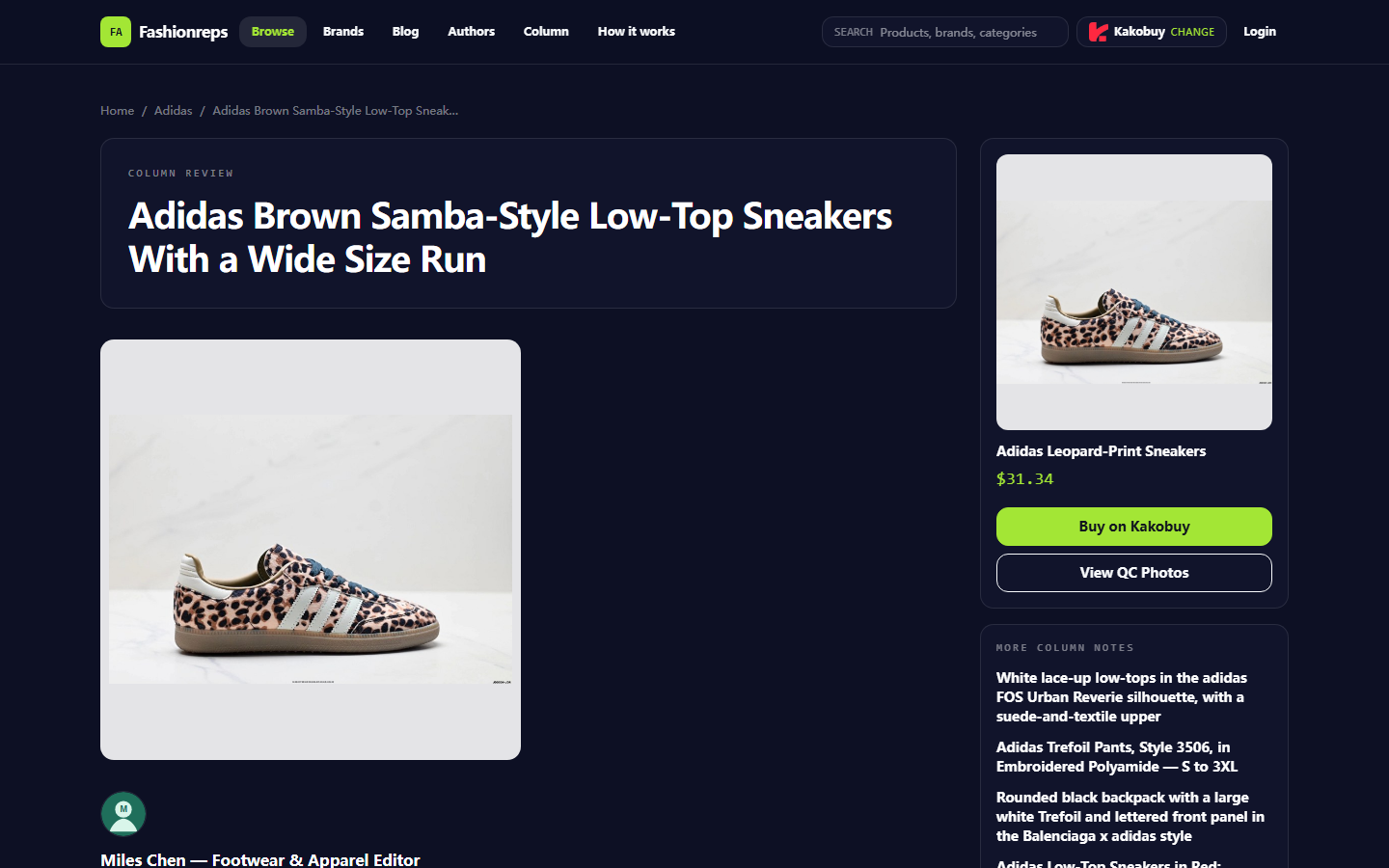
The verifiable sample page describes the product as Adidas Brown Samba-Style Low-Top Sneakers, and the page also includes Samba-line related descriptions. It should not be classified as a professional training shoe without further evidence. If your main use is squats, jumps, quick directional changes, or high-intensity classes, you should ask the agent to confirm the actual model, sole structure, and product category before buying.
Situations suitable for continued verification include:
- You mainly need shoes for commuting, short walks, or everyday styling.
- You already know your usual size in Samba-type shoes.
- You can accept incomplete product page information and are willing to confirm the specific variant before ordering.
Situations not suitable for direct purchase based on page conclusions include:
- You need lateral support or stability features of professional training shoes.
- You need clear cushioning evidence for prolonged standing.
- You must rely on independent buyer reviews, real wear feedback, or complete size data.
Verify the Shoe Type, Size, and Color Fields on the Adidas Product Page
The pre-publish verification record shows that the sample page describes the product as Adidas Brown Samba-Style Low-Top Sneakers, with the style code IH9052 and brown color. The page title line shows a size range of 36 to 45, including half sizes; the specification field shows 35 to 45. The two fields are not entirely consistent, so you cannot determine available sizes just from the title.
The page also shows a reference price of about $31.34, but the final product price, service fee, and international shipping need to be confirmed on the selected shopping agent page. Price, inventory, available colors, and actual sizes are all time-sensitive information, and this article cannot treat that reference price as the current transaction price. The verification basis is the product page content captured by this site, with an update date of September 26, 2026; you need to reconfirm before ordering.
Before purchasing, it is recommended to record the following:
- Whether the product name clearly states the specific shoe type, not just "Adidas sneakers".
- Whether the style code is consistent across the title, specifications, and images.
- Whether the color field matches the main image and variant selections.
- Whether the size range is consistent across the title, specifications, and purchase options.
- Whether the page clearly distinguishes between men's, women's, or unisex.
- Whether the agent page still has your required size and color.
If the title says "training shoes" but the details and images clearly show Samba-style low-tops, treat "training shoes" as a label to be confirmed, not a proven attribute.🔎
Build Visible Evidence from Toe, Upper, Heel, and Outsole Images
Product images only support visible appearance verification and cannot prove comfort, durability, or actual support performance. When checking, you can divide the images into four areas:
- Toe: Observe whether the silhouette is narrow, whether there is an obvious wide design, and whether the toe height is sufficient for your toes.
- Upper: Confirm the material labeling, stitching, and color match the product title.
- Heel: Observe heel height, collar shape, and any visible stabilizing structures.
- Outsole: Confirm the sole pattern and thickness are clearly visible, but do not infer slip resistance or wear level from the pattern alone.
The sample page can support judgments mainly about style appearance, brown colorway, and low-top silhouette. The page does not provide independent cushioning tests, stability data, or wear tests to prove professional training use. Therefore, images can help you rule out obviously mismatched styles, but cannot replace sole hardness, measured weight, or wearing feedback.
The designated reference image is used to verify the style shown on the product page against the page fields, and does not represent actual quality, inventory, or wearing effect:

Distinguish Selection Criteria for Training, Commute Walking, and Prolonged Standing
If the use is daily commuting, prioritize confirming toe room, upper wrap, whether the heel slips easily, and whether the sole flex point matches your gait. For ordinary walking, whether the shoe looks like a training shoe is not key evidence.
If the use is training, you need to additionally verify:
- Whether the sole provides sufficient lateral stability.
- Whether the forefoot allows quick movement and direction changes.
- Whether the heel has a clear stabilizing structure.
- Whether the product page provides a clear training category or sole purpose description.
If the use is prolonged standing, be especially cautious. When the page lacks independent testing, you cannot treat descriptions like "soft sole", "comfortable", or "cushioned" as guarantees for prolonged standing. A safer approach is to first confirm the shoe's positioning, then look for size charts, insole thickness, sole structure, and return/exchange conditions.
The sample page provides sizing hints for Samba-style shoes, not proof of training shoe performance. Therefore, it is more suitable as a candidate for everyday low-tops; if your core task is high-intensity training, pause and look for other models with clear evidence of training use.🚶
Do Not Treat Page Promotions as Conclusions on Cushioning, Stability, or Durability
Words like "training", "sport", "comfortable" or similar on product pages can only serve as clues for further verification if supported by specific structures, parameters, or reliable tests. The following conclusions cannot be directly drawn from the sample page:
- Cannot judge that this shoe suits all training programs just because of the Adidas brand.
- Cannot judge slip resistance or wear life from outsole images alone.
- Cannot judge breathability and durability from upper material names alone.
- Cannot judge quality or value from product price alone.
- Cannot fabricate buyer reviews, real wear experiences, or test results not provided on the page.
The page clearly provides sizing hints: narrow feet may consider choosing your usual size, normal to wide feet may need to go up half a size; also, the page states that leather uppers may feel tight initially and will loosen with wear. This content is a Samba-line sizing reference and should not be expanded to apply to all Adidas training shoes.📏
Handle Incomplete Size Charts, Variants, and QC Information
Sizing judgment should start from three variables simultaneously: foot length, foot width, and shoe shape. First measure your foot length while wearing the target socks, then compare with the product page size chart; if the page only provides EU size ranges without insole length or width information, you cannot convert EU sizes directly into a definite fit.
For this sample, the page title and specification fields have different size ranges, and the page has no independent buyer reviews. Before ordering, confirm the following with the shopping agent:
- Whether the specific size you need is actually available.
- Whether the title's size range matches the inventory options.
- Whether the color variant still corresponds to the brown style.
- Whether the style code IH9052 matches the actual options.
- Whether QC photos cover your selected size and color.
- Whether you can request handling if there are obvious wrong sizes, wrong colors, or noticeable defects.
QC photos can check visible issues such as color, stitching, sole appearance, and obvious differences between left and right shoes, but cannot prove that the shoes will fit. Do not interpret "having QC photos" as "quality assurance completed". If you need to show order, shipping label, or account screenshots, cover your name, address, phone number, order number, and payment information.
Create a Pre-Purchase Shoe Verification Checklist
Before ordering, complete the following checks in order:
- First write down the main use: training, commute walking, short trips, or prolonged standing.
- Confirm the actual shoe type, not just "sneakers" or "training shoes".
- Record the style code, color, size field, and variant options.
- Compare with your foot length and width, and keep the sizing basis.
- Check for conflicts among title, specifications, and inventory.
- Check whether product images support visible verification of toe, upper, heel, and outsole.
- Confirm whether the page has independent reviews, QC photos, and return/exchange instructions.
- Reconfirm price, service fee, inventory, and international shipping on the agent page.
- If the main use is professional training, request evidence of training positioning or structure.
- Save the verification date and agent confirmation result to avoid ordering based on outdated information.
Decide to Proceed, Supplement Verification, or Pause Based on Evidence Sufficiency
You can proceed with purchase when: the actual shoe type matches your use, size and color fields are consistent, the agent confirms inventory, and you accept the limitation of no independent buyer feedback.
You need to supplement verification when: the title and specification size ranges are inconsistent, training use is unclear, QC photo coverage is insufficient, or price and inventory have not been reconfirmed on the agent page.
You should pause purchase when: you need professional training performance, but the product can only be proven as a Samba-style casual low-top; or you cannot confirm the selected size, color, style code, and return/exchange conditions.
This verification method mainly saves the cost of wrong purchases and the time of return/exchange communication, at the cost of extra confirmation of size, variant, and use before ordering. It is more suitable for buyers who value information completeness and are willing to keep verification records; not suitable for those who must buy immediately, cannot accept size field conflicts, or need professional sports performance guarantees. The final judgment should be based on the current product page, agent inventory, QC information, and your actual use tasks, not on brand names or promotional words.