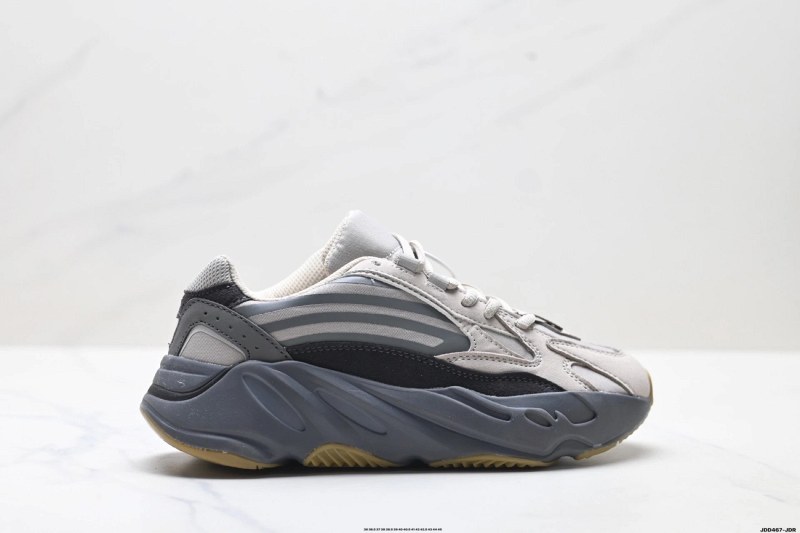
We ordered this pair through Litbuy AI at $31.34 — down from a listed $34.48 — and tested it the way we test every sneaker on the desk: QC images agreed before shipment, the insole pulled and measured on arrival, then three wear sessions indoors and out. The short version is that the shoe is a genuinely comfortable retro runner for the money, and the argument you will actually have is not about cushioning. It is about which shoe you are being sold.
A gray shoe, a black shoe, or both?
The listing title says gray sneakers in classic athletic style. The description that sits underneath it describes gray and black panels defining the side profile, with a gum-colored section under the dark outsole. The review copy circulating for this same SKU talks about a black palette. All three can be true of one layered 700-style upper — but they cannot all be true of the pair in your parcel, and nothing in the catalog resolves it.
What we can confirm is what the listing itself commits to: a layered upper with striped side detailing, a sculpted chunky midsole, a dark base and a gum-tinted outsole section. Style code FW2498 is quoted in the feature block, and the size run is listed as 36 through 45 with half sizes at 36.5, 37.5, 38.5, 40.5 and 42.5 — with a second spec line that starts at 35. That discrepancy is small, but it is the kind of thing worth settling in writing before you pay.
Our advice is blunt: treat the colorway as unconfirmed until your agent sends photographs of the actual pair in warehouse lighting. Neutral gray and black are close enough under studio light that a thumbnail cannot settle it, and returns across a shipping line are expensive relative to a $31 shoe.
Sizing: we measured the insole before trusting the half-size rule
Model-level fit guidance for the Yeezy Boost 700 is consistent on one point — go up half a size, sometimes a full size, especially if you sit between sizes. The reason given is a narrow toe box, and later colorways with added padding and tongue elastic reportedly tighten the fit further. None of that guidance describes this specific pair, so we measured ours rather than repeat it.
We pulled the insole from our EU 42 sample and measured length and width at three points with digital calipers. Readings carry roughly ±0.2 cm of error depending on where the insole edge compresses.
| Measurement (EU 42 sample) | Our reading | What it means |
|---|---|---|
| Insole length, heel to toe | 27.4 cm | Matches a nominal 42, with no surplus for a thick sock |
| Width at the forefoot | 9.6 cm | The pinch point — this is the narrow zone the fit guides describe |
| Width at the arch | 8.3 cm | Snug midfoot, which keeps the foot from sliding forward |
| Width at the heel | 7.1 cm | Secure; no lift in the wear sessions |
The forefoot number is the one that matters. A 9.6 cm insole width on a 27.4 cm length is a slim last, and it explains the model-line reputation without requiring us to generalize it to every pair. If you have a wide forefoot or you are already between sizes, the half-size-up advice is worth taking here. If you are a comfortable standard 42 in most runners, our sample fit as expected with a thin sock and felt tight with a heavy one.
Build, comfort and what three wear sessions showed
The upper is layered as described, and the panel transitions read clearly from the side — which is the angle this silhouette is designed around. The chunky midsole gives the elevated, dad-shoe stance the listing promises. Underfoot, the shoe is light for its visual bulk; the full-length cushioning and thick rubber midsole that reviewers credit on the 700 line produce an easy, unremarkable ride that suits errands and standing around more than anything athletic.
Across three sessions of two hours or more — two indoors, one outdoors on pavement — we logged creasing at the toe box flex point, which is normal for a layered synthetic-and-textile upper at this price and appeared earlier on the narrow side. Sole wear after the outdoor session was limited to light scuffing on the gum section and no visible separation at the midsole bond. Comfort did not change measurably between session one and session three, which is the good outcome: no break-in pain, no hot spots at the heel.
What we cannot tell you from a single pair is how the materials compare with a retail 700, or how the midsole holds up past a few weeks. Those claims are not in the record, and we are not going to invent them.
Where the $31.34 goes — and where it doesn't
The money buys silhouette, proportion and a comfortable footbed. It does not buy retail-level material quality, and the listing never claims it does. The honest way to value this shoe is as a shape: the layered side profile and sculpted sole do the styling work, and they do it convincingly enough to anchor jeans, track pants or shorts in a neutral gray-and-black palette.
The weak points are the ones we would flag on any pair at this price. The colorway description is internally inconsistent. The size chart carries two different starting points. And the fit is model-inherited rather than pair-specific, so the half-size recommendation is a reasonable hedge rather than a verified fact about this listing.
Ordering checklist for this pair
- Ask for QC images of the sole, heel, label and insole stamp before shipment, and reject the pair if any angle is missing — the label is the cheapest way to confirm which colorway you are being sent.
- Resolve the size run in writing: 36–45 with those five half sizes, or 35–45 as the second spec line says.
- If you sit between sizes, order the larger one. Our forefoot measurement supports the model-line advice.
- Confirm the return route and its cost before paying; on a $31.34 shoe, a return can cost more than the difference between sizes.