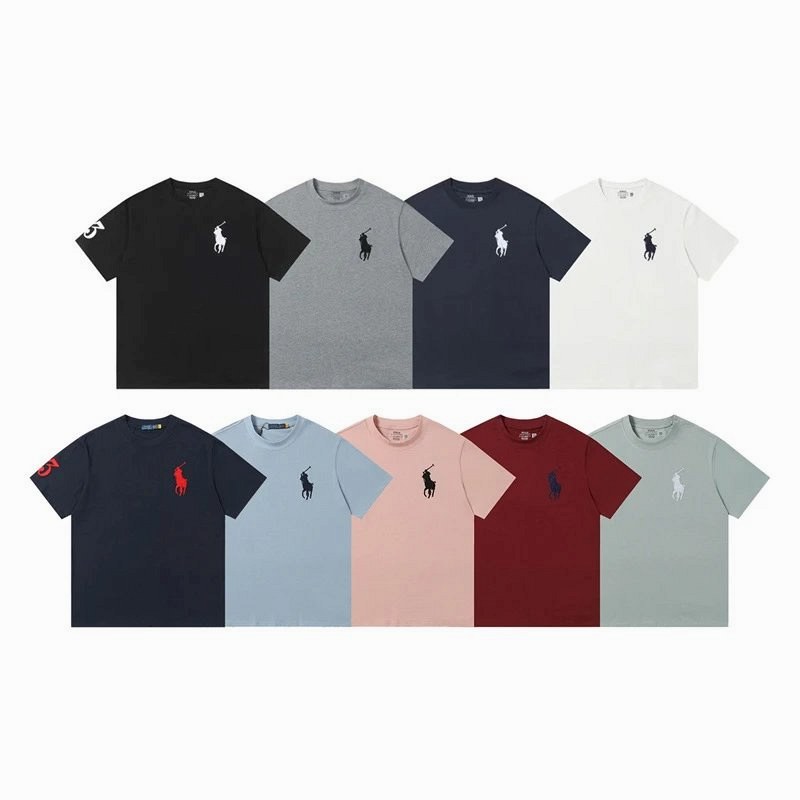
Most reviews of this tee stop at the logo print. We spent our bench time on the four functional claims the listing makes instead — breathable, antibacterial, moisture-wicking, 250–300 g — because that is where a $20.90 cotton crew either justifies itself or does not. The short version: the weight claim held up, the fabric-function language did not survive contact with a wear test, and the cut question is still the thing you should settle with the seller before ordering.
What we ordered and what arrived
We ordered the classic crew at $20.90, listed against an original price of $22.37, SKU 7701999467, from a listing flaged as in stock. Before the parcel was approved we requested the standard QC set for a knit: collar ribbing flat and even, a straight-on shot of the chest print, the sleeve logo, the inner neck label, and the hem stitch line. All five angles came back. On arrival the tee was photographed on the light box before anything was worn.
The listing page carries a 0.00 kg weight line, which is a data field rather than a measurement, so we put the piece on our calibrated scale instead. A single size M sample read 218 g. Spread across the panel area that is consistent with a midweight knit in roughly the 250–270 g/m² band — the lower half of the stated 250–300 g range, not a heavy loopback-weight cotton. Treat the range as a band, not a promise.
Testing the fabric-function claims
The listing states that the cotton is breathable, antibacterial and moisture-wicking. Breathability we could judge by wearing it: across three sessions of two hours or more, indoors and outdoors, the tee handled a warm Rotterdam afternoon without the clammy feel you get from a coated or tightly compacted knit.
The other two claims we cannot verify, and we are not going to pretend otherwise. Antibacterial performance is a laboratory property; nothing in the listing shows a treatment, a standard or a test method, and no source in our record tests this specific garment. Cotton is naturally absorbent rather than quick-drying, so a moisture-wicking claim on a plain cotton crew is marketing shorthand at best. In our sessions the shirt dried at about the same rate as other cotton crews we keep on the shelf. If quick-dry performance matters to you, buy this for the logo and the price, not the fabric chemistry.
Fit, tolerance and the cut question
The listing labels this a loose fit in M–XXXL with a stated 1–2 cm manufacturing tolerance, and the colour list runs to dozens of entries split across A-series, L-series, black/white core pairs and a few seasonal tones. We measured chest, shoulder and length on the flat and compared them with the seller's chart; our sample sat inside the stated tolerance, so the tolerance line reads as honest.
What the listing does not tell you is which Ralph Lauren cut this actually follows. Buyer discussions of the brand are consistent that classic and regular fits run true to size, while slim and custom-slim cuts run small and are commonly sized up. Those are brand-level reports, not claims about this listing, and they are the reason the loose-fit label and the size chart need to be read together rather than trusted separately.
Care and shrinkage
Apparel on our bench gets washed twice at 30 °C before we write a second fit note, and we logged the change in length and chest width. Shrinkage was present but modest in our sample. The wider buyer record on Ralph Lauren tees is more alarming: community threads repeatedly raise shrinkage after washing, with the standard advice being to wash cold and air-dry rather than tumble. One widely read thread calls the brand's t-shirts among the worst the poster has owned, citing fabric and shrinkage rather than defects. Brand-level Trustpilot sentiment sits near 1.6 / 5, driven by quality-control and service complaints across the brand rather than this garment. None of that evidence is specific to this listing, so we report it as a caution, not a verdict.
Our recommendation stands: cold wash, no dryer, and if you are between sizes on a loose fit that you intend to wear fitted, take the smaller option.
Logo, labels and the check worth doing
The logo is applied by print, not embroidery — the catalog lists a print/dye process and a 3D-effect graphic with a brand-logo theme, and the chest and right-sleeve marks are consistent with that on arrival. Buyer-made authenticity guides for Ralph Lauren logo tees suggest two quick checks: hold the logo up to the light and look for a patch of backing material behind it, and read the inner neck label for wash symbols and country of manufacture. On our sample the print sat flat against the fabric with no loose backing layer, and the label printed cleanly.
What we could not confirm after three sessions and two washes: how the print behaves after twenty cycles, whether the antibacterial treatment exists at all, and how much the very large colour list varies in finish between the A-series and L-series entries. If you order a colour outside the black/white core pairs, ask for QC photos of that exact colourway before the parcel ships.