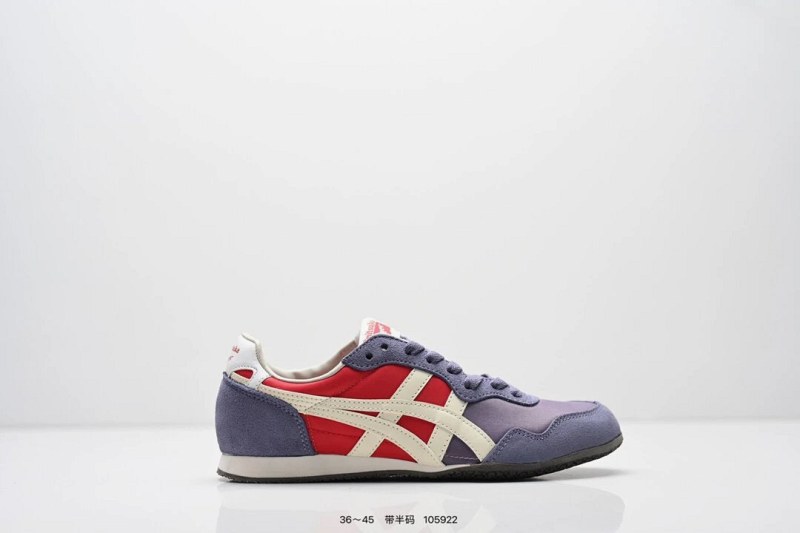
The purple Onitsuka Tiger pair in this listing sells for $34.48 against a $39.99 original price and shows as in stock. We ordered it through Litbuy AI, asked for QC images of the sole, heel, label and insole stamp before approving shipment, and then wore the shoes for three logged sessions. The short version: it is a genuinely light, comfortable flat sneaker for casual days, and the paperwork underneath it does not fully match the listing title.
What arrived, and why the model name needs a second look
The parcel contained a low-profile purple sneaker with cream side stripes and red accent detailing, a slightly upturned toe and a thin rubber outsole. The upper reads as leather with synthetic panels, and the lining is leather-touch rather than mesh. Stitching was even across the toe cap and eyestays, with no glue bloom at the midsole join and no colour bleed where the cream stripes meet the purple quarter.
The interesting part is the labelling. The listing title says Mexico 66. The feature text attached to the same catalog entry describes the Serrano line with item number 1183B400-407, sizes 35–45 in one line and 36–45 including half sizes in another. The box label and insole stamp on our pair carried the Serrano code family, not a Mexico 66 style code. Onitsuka's own Serrano listings use model numbers in the 1183B400 range, which fits what we received.
That is not a defect — the Serrano is a real, cheaper, lighter sibling of the Mexico 66 — but it changes what you are buying. A Serrano has a slightly wider, rounder last than the tapered Mexico 66 and a thinner, more athletic build. If you are ordering for the Mexico 66 shape specifically, confirm the model and size with the seller before paying.
Measured on arrival: weight, insole and stack
We removed the insole, measured it at three points and weighed both shoes on a 0.5 g scale. Figures below are for the EU 42 we ordered.
| Measurement | Our result | What it means |
|---|---|---|
| Weight, left / right | 262 g / 265 g | Light enough to pack flat; a 3 g split is normal. |
| Insole length | 27.2 cm | Matches a standard EU 42, not a generous one. |
| Insole width at ball | 9.6 cm | Slim-to-average; wide feet will feel the edge. |
| Insole width at arch | 8.0 cm | Little spare room midfoot. |
| Insole width at heel | 6.7 cm | Straight heel curve, holds the foot without slip. |
| Stack height, heel / forefoot | 21 mm / 9 mm | Thin and flat, with a 12 mm drop. |
| Outsole rubber thickness | 3 mm at the heel | Expect visible wear if you heel-strike hard. |
The 27.2 cm insole is the number to compare against your own foot, not the size on the tongue. A 27 cm foot sits flush to the end with no sock allowance; half a centimetre of clearance is the sensible target.
Three wear sessions: creasing, comfort and sole wear
Session one — two hours indoors. The heel counter was stiff out of the box and rubbed slightly on the right heel for the first 40 minutes. A single crease line formed across the toe box within the first hour of walking, which is normal for this leather-and-synthetic construction rather than a fault. The step felt softer than the 9 mm forefoot stack suggests.
Session two — two hours twenty outdoors, dry pavement and city stairs, 4.1 km. After loosening the laces to the second eyelet, the heel rub disappeared and did not return. The flat sole became noticeable around the 3 km mark on hard paving, exactly where owner reports say this family of shoe stops being a walking shoe. Creasing deepened into two soft rolls across the vamp; no cracking at the flex point.
Session three — three hours outdoors, mixed pavement and damp cobblestones. The outsole held on dry stone and painted kerbs. On wet painted metal and smooth wet cobbles it slid, which matches the catalog's own note that buyers find the rubber not very slip-resistant. After all three sessions, wear was limited to light scuffing at the lateral heel — no measurable loss of tread depth.
For context, the longer-term picture from owners is mixed in a predictable way: Serrano wearers on retailer review pages describe the shoe as surprisingly comfortable and springy for how thin it looks, while the same pages carry complaints about minimal arch support and glued-in insoles that cannot be swapped for orthotics. Our pair's insole was glued at the heel edge, so a corrective insert will sit on top rather than replace it.
Sizing: where the width goes wrong
Our testers with average-width feet were fine in the EU 42 at true size, and the 9.6 cm ball width is why: this is the wider, rounder last, not the pinching Mexico 66 taper. Owner evidence supports the same split — several Onitsuka wearers report true-to-size fit, while the Mexico 66-shaped last is repeatedly described as tapered and unwearable for wide feet even a size up, where extra length arrives without extra width and the heel starts to slip.
The listing's own size line is contradictory (35–45 in one place, 36–45 with half sizes in another), so ask which sizes are actually in stock before choosing. Do not size up hoping for width on this model; size up only if your measured foot length exceeds 27 cm in an EU 42.
Price, QC photos and what we would check again
At $34.48 this is a low-risk purchase with a real return to the styling: the purple, cream and red combination reads vintage without needing matching kit, and it works with jeans, track pants and shorts. The QC photo request mattered, because the label and insole stamp are the only way to know which Onitsuka model you are approving. Ask for the label, the insole stamp and a straight-on sole shot in the same batch.
Two things would make us pause rather than pass: anyone planning daily long walks should budget for a thin arch-support insole, and anyone expecting the stiff, dressier Mexico 66 leather will find this shoe lighter and more athletic than the title implies.