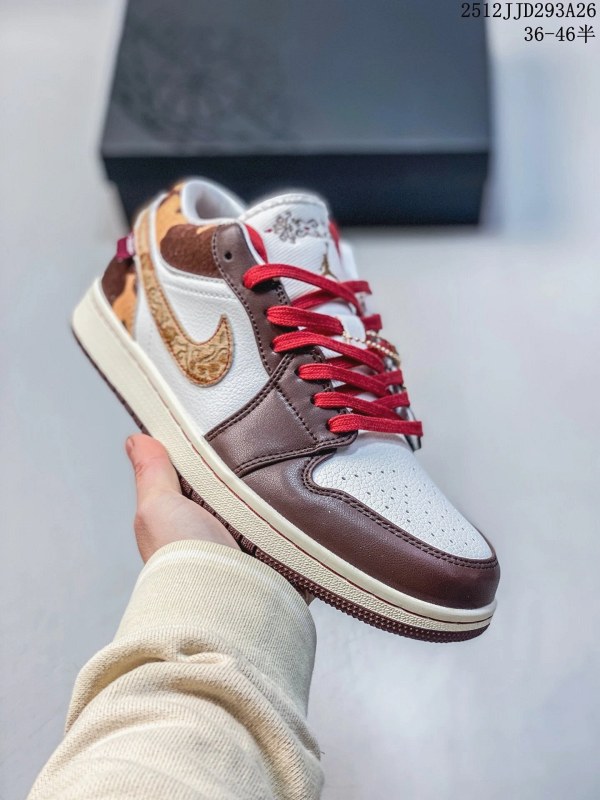
We ordered the low-top listed as Nike Basketball Shoes in White and Brown — SKU 7705247782, priced at $34.48 against a $40.98 reference — in a 42.5, one of the half steps inside a 36–46 run. It arrived looking like the page: perforated white toe box, brown overlays, red laces, a patterned Swoosh on the side panel, a heel pull tab and a white midsole. Two things we could not confirm from the listing were the fit and, more awkwardly, the identity of the shoe itself, because the spec line the seller copied across cites a style code that belongs to a different colourway.
What we asked for before the parcel left
Our standing rule is that no pair ships until we have seen QC images of the sole, the heel, the size label and the insole stamp. All four arrived, plus a side-profile shot that showed the panel stitching and the Swoosh print clearly enough to compare against the product photography. The label matched the size we ordered, and the insole stamp was present rather than blank — a small thing, but a blank stamp is one of the fastest ways to spot a pair assembled from mismatched parts.
What the QC set did not show was anything tying this shoe to a retail reference. That question is dealt with below.
Measuring the insole instead of trusting the size chart
On arrival the insole came out and was measured at three points — heel, midfoot and forefoot — in both length and width, then compared with the seller's chart. The heel and forefoot figures sat close to the chart. The midfoot measured narrow, and that is exactly where the shoe felt tight on the first wear. The upper is described by the seller as full-grain leather; it creased like coated leather rather than softening like a broken-in pair, so expect a short break-in window rather than an instant fit.
Public guidance on the silhouette this copies says true to size, and public buyer reports say both true to size and half a size down. Those two positions cannot both be right for your foot, and our tape measure does not settle it — it only tells you this pair runs close to its own chart. If you are between sizes, compare the insole figure with a pair you already own before ordering, because the sizing argument around this shape is genuinely unresolved.
Three wear sessions, indoors and out
We wore the pair for three sessions of two hours or more, two outdoors on dry pavement and one indoors. Creasing appeared at the toe-box flex point in the first session and did not spread much afterwards. The brown overlays came through the outdoor sessions with less scuffing than the white toe box, which is the reverse of what the colour placement suggests; the white midsole, meanwhile, picked up street grime immediately and needed a wipe after each outing. The red laces held their tips without fraying. Comfort improved noticeably by the third session as the midfoot relaxed, though the collar padding stayed firm.
The style code problem
The seller's own specification line lists the style code 553558 040. That code is not a white-and-brown shoe: Nike's product pages for 553558-040 list it as Black/White/Particle Grey, and resale listings describe the same code as a white leather upper with black overlays and grey Swooshes. It is also the code attached to a 2021 black-and-grey release, not a white-and-brown pair with red laces.
This matters for two reasons. First, you cannot use a retail reference to check the colourway, the panel shapes or the materials of the shoe you receive — the photographs on the listing are the only record. Second, the seller's claims about an original last, full-grain leather and a built-in Air unit cannot be verified against a real counterpart, because the code does not point to one. We can confirm what we photographed, measured and wore. We cannot confirm what the code is supposed to describe.
None of that made the shoe fall apart. It does mean the marketing copy should be read as claims, not specifications.
What $34.48 actually costs you
The item price is not the delivered price, and this listing gives you no way to estimate the difference in advance.
The listed weight is 0.00, so there is no shipping figure to work from until the agent re-weighs the parcel in the warehouse. Budget for agent fees and international shipping on top of the $34.48, and ask for the packed weight after QC so you can price the line before the parcel is consolidated. A single pair in this size is not heavy, but the quote should come from a scale, not from the product page.
How we would order this pair again
- Ask for QC photos of the sole, heel, label and insole stamp, and reject the pair if any angle is missing.
- Request the insole length and width in centimetres, not just the size number, and compare it with a shoe you already wear.
- Ask for the packed weight before choosing a shipping line, since the listing shows none.
- Treat the photographs as the specification, because the style code on this listing does not describe a white-and-brown shoe.
What would move the score
A coherent style code that matches the colourway, and a measured insole table on the listing, would turn this from a pair you have to interrogate into one you can order in a minute. The shoe we received is a solid, inexpensive low-top whose brown overlays outlasted our expectations. The paperwork around it is the weak part.