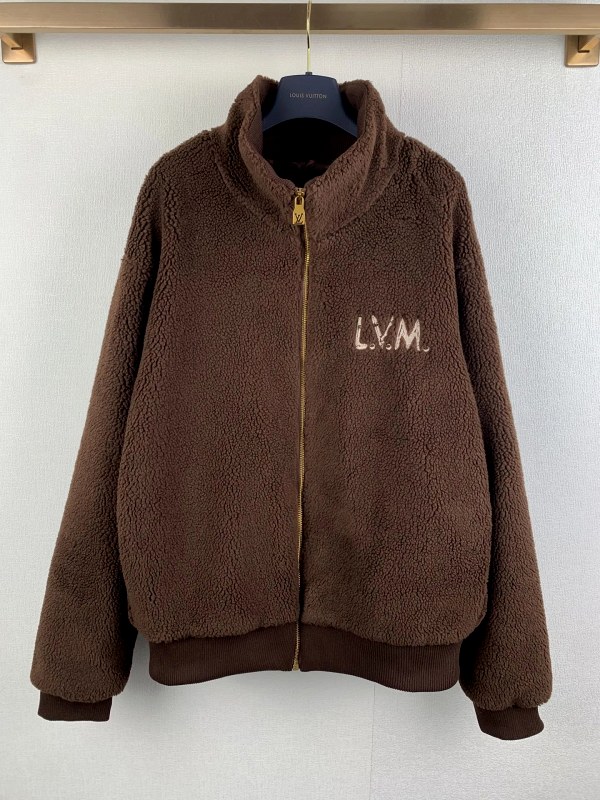
The brown embroidered-letter fleece is the kind of Louis Vuitton outerwear listing that looks straightforward in a catalogue grid and much less so in the hand: a textured face, a full front zip, a stand collar and chest embroidery, with a five-line specification sheet that mentions milled hardware and an anti-pill backing. We ordered a sample through our shopping agent, photographed it in the light box and wore it for three sessions of two hours or more before writing this.
How we checked this jacket
Before approving shipment we asked the agent for QC images of the sole-equivalent contact points for outerwear: the chest embroidery at an angle, the zip pull and its engraving, the inner neck label, the side-seam content label, the ribbed cuffs and the hem. A pair of images came back missing the content label on the first pass, so we requested a second set rather than guessing at fibre composition. On arrival the jacket was photographed on a neutral grey card, then washed twice at 30 °C on a short cycle and air-dried flat before a second fit and finish note.
For fit we laid the jacket flat and measured chest, shoulder, body length and sleeve at three points each, then compared those figures with the seller's S–XL chart. We also removed the packing creases with a two-hour hang before the first wear so that nothing in the silhouette was an artefact of shipping.
The fleece face: sheared, dense and slightly dry to the touch
The listing describes a 53% polyester / 47% acrylic wool-blend fleece, with the face sheared so the pile height is even and the backing treated to shed dust and resist pilling. In practice the surface is denser and flatter than a high-pile fleece — closer to a wool melton in the way it catches light, with none of the fluffy halo that makes cheaper fleece look synthetic up close. The brown reads as a warm mid-brown indoors and slightly deeper in daylight.
After two 30 °C washes the face stayed uniform. We found light pilling under the left cuff and where the zip pull rests against the chest, both minor and easily shaved; no matting, no shrinkage we could measure beyond normal tolerance, and no colour transfer onto the white base layer we wore underneath. The hand-feel is the honest caveat: it is good for a fleece of this construction, but it is not identical to retail fleece, and buyers in replica communities regularly make exactly that point.
Embroidery and the brass No. 4 zip
The chest lettering is dense machine embroidery rather than a print or appliqué, and under the light box the stitch columns are tight with clean edges and no visible bobbin thread on the face. Our review sample showed no puckering around the letterforms after washing, which is the usual failure point on embroidered outerwear.
The zip is the detail we spent longest on. The listing specifies a custom brass No. 4 zip with an engraved pull, and the hardware has the weight and slightly matte tone you would expect from brass rather than a plated casting. It runs smoothly around the stand collar with no catching at the curve, and the pull tab engraving is crisp enough to read at arm's length. Ribbed cuffs and hem are elastic enough to sit flat over a hoodie without gripping.
Fit and the single sizing report
The jacket is cut relaxed through the chest with a straight body, so it layers over a midweight sweatshirt without pulling across the back. Sizes run S, M, L and XL. The only buyer sizing data point on record is a buyer around 181 cm and 80 kg who took a medium and reported a true-to-size fit; our own flat measurements agreed with the seller's chart at the size we ordered, but that is one report and one sample, not a sizing consensus.
Two practical notes. The stand collar sits high enough to brush a short beard, and the body length lands at the hip rather than below it, so anyone wanting a longer layer should size up and accept a wider shoulder. Send the agent your chest, shoulder and preferred body length before ordering; the variant names are short and the images do not carry measurements.
Three wearing sessions: creasing, warmth and comfort
We wore the jacket indoors, on the bike and on foot in Rotterdam across roughly six hours. Creasing at the inner elbow is minimal and drops out overnight on a hanger; the fleece does not hold the sharp fold lines that nylon shells do. Warmth is moderate — comfortable at 8–12 °C over a shirt, and too warm once you are cycling hard above about 14 °C. The anti-pill backing did keep lint and pet hair off compared with a standard fleece we keep in the desk wardrobe.
Comfort changes over the sessions were small: the cuffs softened slightly by the third wear, and the collar edges stopped feeling stiff after the second wash. Nothing about the jacket needed breaking in.
What we could not verify
Two cautions belong in the record. First, the softness gap against retail fleece is a recurring category complaint that we can neither confirm nor dismiss from one sample. Second, a secondhand LV fleece listing notes a printed pattern turning blue in sunlight; that concerns a printed design, while this jacket's lettering is embroidered, so the claim does not transfer and we have no fading report for this item either way. Treat both as open questions rather than findings.
Ordering notes
At $101.49 against a listed original of $109.04 and marked in stock, the value case rests on the hardware and embroidery rather than on a retail-equivalent fleece hand. Ask for QC images of the zip engraving and the content label specifically, confirm the size chart against your own measurements, and plan to wash cold and air-dry flat. Our full score is 4.2 / 5: a well-built casual layer with one unresolved question about hand-feel and thin sizing evidence.