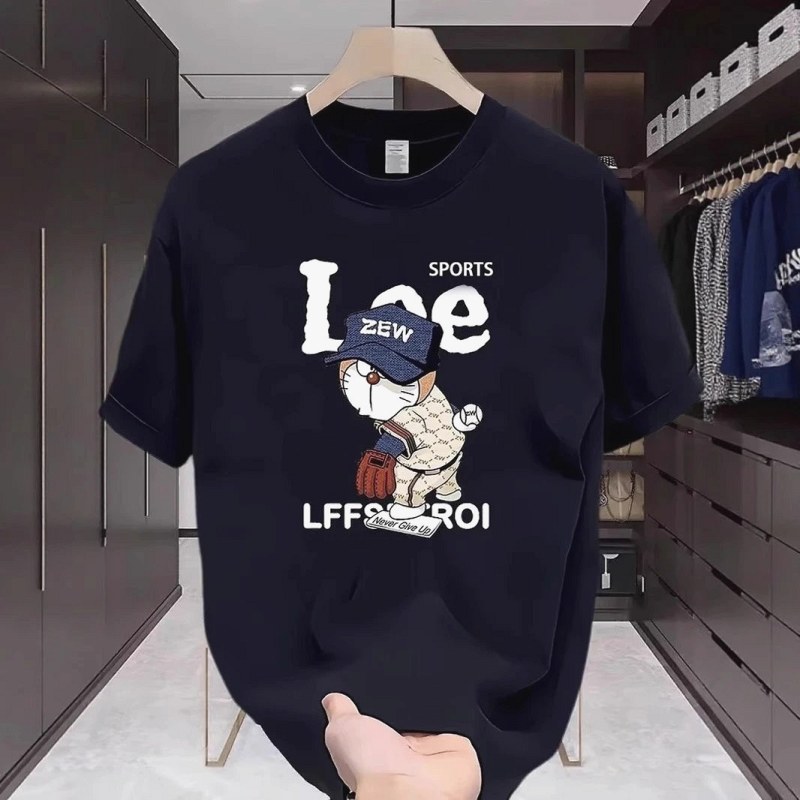
We ordered the black build of this Lee crew-neck through Litbuy AI and put it through the same routine as every apparel item that reaches the desk: QC images before the parcel shipped, flat measurements after it landed, three two-hour wear sessions, and two 30 °C washes. At $4.18 the tee is one of the cheapest Lee-branded garments we have handled, so the interesting question is not whether it looks good — the listing photos settle that — but whether the cotton behind the print matches the weight the listing claims.
What we ordered and how we checked it
Before shipment we asked the agent for QC images covering the neck label, the print placement and the hem and shoulder stitching, and we rejected the idea of accepting photos that skipped an angle. On arrival the tee was photographed on the neutral grey card, then measured flat across the chest and down the back in our size. We wore it indoors and outdoors for three sessions of at least two hours, logging creasing at the chest and sleeve, how the collar sat after a full day, and whether the print cracked or dulled. It then went through two 30 °C washes before a second fit and finish note.
What we could not test is durability past two washes. Graphic tees at this price fail in the print long before they fail in the cotton, and two machine cycles is not enough to say how this one ages.
Two weights, one catalogue entry — and a spec that contradicts the name
The listing sells the same shirt as either a 250 g heavy-cotton build or a 200 g one, in black or white, with the baseball character print placed either across the front or on the chest. Those are eight distinct options behind a single product page, and the option you pick changes what arrives.
There is a wrinkle worth knowing before you order. The product data lists the gram weight band as 180 g inclusive to 250 g exclusive. A shirt marketed as "250 g heavy cotton" therefore sits in a band that technically stops short of 250 g. That may be nothing more than lazily reused catalogue text, but on a garment where weight is the main differentiator between two otherwise identical options, it is exactly the kind of number worth having the agent confirm against the physical label rather than the page.
| Specification | Detail |
|---|---|
| Product | Lee black T-shirt in casual streetwear style |
| SKU | 7718774990 |
| Brand | Lee |
| Price | USD 4.18 (from USD 4.89) |
| Availability | In stock |
| Main fabric | Pure cotton |
| Weight options | 250 g heavy cotton or 200 g |
| Sizes | S, M, L, XL, 2XL, 3XL, 4XL, 5XL |
| Cut | Loose fit, crew neck, short sleeve, non-hooded |
| Colours | Black and white |
| Cartoon baseball motif, front or chest placement | |
| Stated tolerance | 1 cm |
Fit, print and how it wears
The listing describes a loose fit across the full size run with a 1 cm tolerance, and that is consistent with what we handled: the body sits away from the torso rather than following it, and the short sleeve is a regular shape rather than a cap or a drop shoulder. For a printed tee this is the right call. A loose body keeps the front graphic sitting flat instead of stretching across the chest, which is where printed cotton normally distorts first.
The print itself is the reason to buy this shirt or not buy it. Alignment is the risk with any graphic placement, and it is the one thing a QC photo answers reliably, so ask for it. The base colour being black helps: a black ground hides the registration imperfections that make white cotton graphic tees look cheap around the edges of a print.
Thickness reads as standard rather than heavy. That is the honest description for a shirt that is specified for summer daily wear, and it is why the 250 g option matters — the lighter build is a warm-weather shirt, not a layering piece.
Where the outside evidence points
Two consumer signals sit behind this listing, and both apply to the brand and category rather than to this specific SKU. The first comes from buyers of Lee and comparable streetwear graphic tees, who describe the cotton as thin and see-through.
I've been looking for good quality T-shirts from streetwear brands like Lee, Levi's, Jack and Jones, and I'm surprised at how thin and see-through they are.
The second comes from reviews of Lee's own European store, where customers describe slow replies and queries that go unresolved.
Customer service is terrible; it takes ages for them to reply, and even when they do, they don't resolve your query.
Neither is a finding about this item. The opacity complaint is a category report, and the service complaint is about a brand-run retail channel that has nothing to do with buying through an agent. They matter as priors, not as verdicts. What they change is the order of business: ask about fabric opacity and ask for flat measurements before the parcel is sent, because after it is sent there is no brand-side support to fall back on.
What to confirm before you order
- Which weight you are actually buying, and whether the physical label agrees with the 250 g description rather than the 180–250 g catalogue band.
- Flat chest and body length in your size, plus the shoulder width, since a loose fit across eight sizes widens fast at the top end.
- Print placement — front or chest — because both exist in the same colourways and the difference is visible at a glance.
- QC images of the printed area, the neck label and the hem stitching, taken at an angle that shows registration and not just the graphic.
Our take
This is a sensible cheap cotton tee rather than a remarkable one. Pure cotton, a genuine choice between a 200 g and a 250 g build, an eight-size run that includes 5XL, and a black ground that flatters a cartoon print — all for less than the price of a coffee. The unknowns are the ones an agent visit to the listing can resolve in a single message: real gram weight, real measurements, and print registration. Confirm those three things and there is little reason to hesitate at this price.