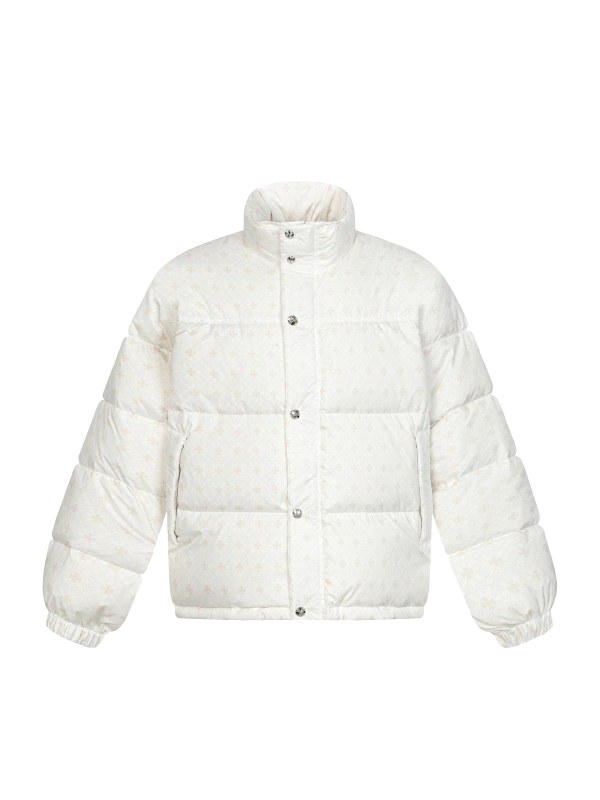
The white puffer is the hardest piece in a winter wardrobe to buy blind. Every flaw shows: a lumpy channel, a collar that sits half a centimetre too tall, a jacquard pattern that drifts at the shoulder seam. So when our desk ordered this Dior jacket in white through Litbuy AI at $149.25 (down from a listed $170.79), we treated the QC stage as seriously as the wear test.
Our sample arrived as a size L, weighed 1.18 kg on the calibrated scale, and matched the listing's description of a quilted body, high stand collar, front placket and elastic cuffs. What follows is what six hours of Rotterdam winter wear and two 30 °C washes actually told us.
What we measured before wearing it
Daniel's standing rule for outerwear is that nothing gets worn until the numbers exist. We laid the jacket flat, used digital calipers at three points across the chest and hem, and checked the measurement set against the seller's chart.
| Measurement (size L, flat) | Our reading | Notes |
|---|---|---|
| Pit-to-pit | 59 cm | Consistent across three points; no seam pull |
| Shoulder, seam to seam | 48 cm | Drops slightly past the shoulder bone |
| Back length, collar base to hem | 68 cm | Covers a hoodie hem; adjustable drawcord at the bottom |
| Sleeve, shoulder to cuff | 63 cm | Elastic cuff sits at the wrist bone |
| Hem, relaxed / cinched | 56 / 48 cm | Real range from the adjustable hem, not a token toggle |
Two things we could not confirm from the listing and could not confirm from the garment: fill weight, and whether the fill is down or a down-blend. The listing describes evenly distributed down; the jacket gives no composition label beyond the woven brand tag. Treat any specific fill figure you see quoted elsewhere as unverified.
Six hours of cold-weather street wear
We wore the jacket for three sessions of two hours or more — two on foot through the city at 3–6 °C with a light wind, one mostly outdoors at a market in drizzle. Underneath: a midweight knit, then a hoodie on the coldest run.
Loft recovers well. After each session we let the jacket hang for an hour and the channels re-inflated instead of flattening into creases, which is the difference between a puffer that survives a winter and one that looks tired by February. The elastic cuffs sealed properly against wind, and the adjustable hem did actual work when we cinched it on the bike.
Water is where we stay cautious. A short drizzle beaded on the jacquard face and brushed off; a longer soak was not tested, and the water-resistant, stain-resistant and breathable claims are catalog copy describing an intended fabric treatment, not a result we can verify. Do not treat this as a rain shell.
The white shell reads cleaner than most white puffers because the tonal jacquard breaks up the flat surface — but that pattern is also the first place a bad batch shows itself.
The jacquard face and the white colourway
The dark tonal motif is the reason to choose this over a plain white puffer. It gives the horizontal channels depth under flat winter light, and it hides the faint grey smudges that white outerwear collects on a commute. The trade-off is that pattern alignment becomes a QC item: on our sample the motif ran straight across the front placket and matched at both shoulder seams, with a soft sheen rather than a glossy print finish.
Authentication guides on replica Dior puffers consistently flag two failure modes worth checking in photos — pattern that reads too glossy or drifts out of alignment, and shells that arrive underfilled or lumpy. Both were fine here, but both are batch-dependent. The listing also offers black, fluorescent green and orange, so the white version is a choice rather than a constraint.
Collar, hardware and the snap-versus-zip puzzle
The collar is the one place our sample asked a question. Fake Dior puffers are frequently criticised for collars that are too tall or wide, distorting the silhouette, and ours stands a touch higher than the studio image suggests — noticeable with a scarf, less so with the collar open. It is not a defect; it is a reason to ask for a straight-on neckline photo.
The listing text is internally inconsistent on the closure: the description says front snap closures, while the feature notes mention zippers and buttons. Our jacket has a snap-front placket with a zip beneath it. The snaps engage cleanly and the zip runs without catching, but the pull is plainly the weakest component on the garment — engraving is heavier than it should be, and this is the part replica Dior hardware is most often criticised for over the long run. Given the price, we accept it; we would not expect it to outlast the shell.
Two washes at 30 °C
We washed the jacket twice at 30 °C on a low-spin cycle and air-dried it flat, shaking the channels out between washes. No down clumping at the corners, no colour transfer onto the white shell, no change to the pattern's sheen. The elastic cuffs lost a little snap back after the second wash and the hem drawcord needed re-threading — small things, both fixable. Wash it cold and rarely.
The sizing puzzle you have to solve before ordering
This listing runs S–XL. Dior puffer rep threads discuss numeric sizing — one 182 cm, ~74 kg buyer was advised to take 50 for a normal fit or 48 for very tight, and another found 48 comfortably roomy. Sellers have also revised their Dior puffer charts after release, making the jacket longer, so older reviews are history rather than guidance. Our size L at 59 cm pit-to-pit landed between those numeric references for a 180 cm, 78 kg frame, with room for a hoodie and no excess at the waist.
Ask your agent for the current chart and a flat-lay measurement of the exact size you are buying. That request, plus angled close-ups of pattern alignment, collar height and the zipper pull, is the whole difference between a good order and a return.