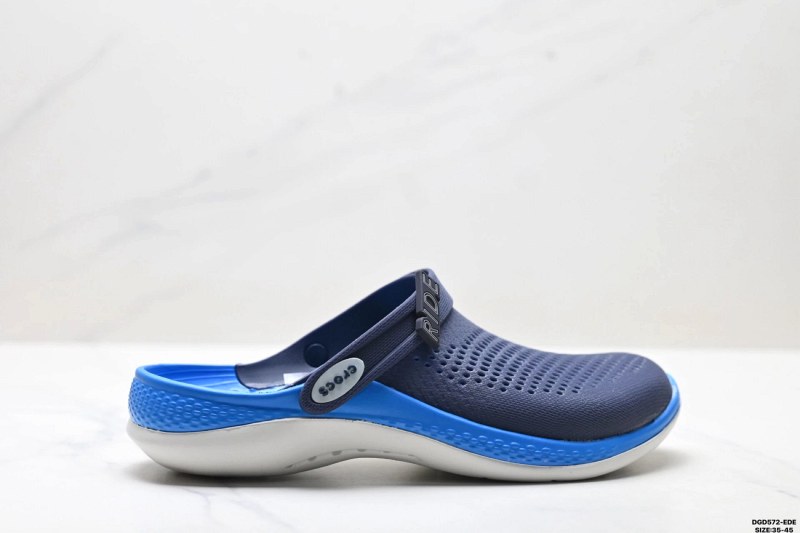
A dark blue perforated upper, a bright blue midsole, a white outsole and a pivoting heel strap: the Crocs Dark Blue Tri-Color Slippers are a LiteRide 360-style clog listed at $18.81, down from $20.80. That is roughly half what the same silhouette asks at full retail, which is the reason we ordered a pair rather than scrolling past it.
Our testing team put it through the desk routine: QC photographs before shipment approval, insole measurement on arrival, then three wear sessions of two hours or more, indoors and out. What follows is what the bench work and the foot time actually showed.
What arrived and how it is built
The listing describes a knit-like upper intended to sit softer and more breathable against the foot, a LiteRide 360 EVA foam outsole, and a visible three-layer contoured sole profile. In the hand, the upper reads as a soft molded EVA with a fine perforated texture rather than a woven textile — the "knit-like" wording describes the surface feel, not the construction. The three-layer sole is the visually dominant element: dark blue above, a saturated mid-blue band, then a white outsole that wraps slightly up the sidewall.
The pivoting heel strap is riveted rather than glued, moves through its full arc without scraping, and can be flipped forward for a slip-on fit or back for a locked-in one. Sole flex is concentrated under the ball of the foot, which is where we would expect it on a foam clog at this weight.
| Catalog detail | What the listing states |
|---|---|
| SKU | 7702265639 |
| Price | $18.81 (from $20.80) |
| Availability | In stock |
| Size run | 35–45 |
| Upper | Dark blue perforated, knit-like surface claim |
| Sole | LiteRide 360 EVA, three-layer contoured profile |
| Trim | Bright blue midsole, white outsole, pivoting heel strap |
How we checked the pair before wearing it
Before approving shipment we request QC images of the sole, heel, label and insole stamp, and we reject a pair when a requested angle is missing — on this order all four came back legible, including the molded size stamp under the heel and the branding on the insole. On arrival we pulled the insole and measured length and width at three points, comparing the numbers against the seller's 35–45 chart.
That measurement is the reason we are cautious rather than triumphant on fit. The chart is a coarse map at best, and the three-point check told us the insole is consistent within the pair but that the upper's interior volume is generous relative to the printed size.
Sizing: the one question we cannot close
This is where the evidence splits, and we would rather say so than paper over it. Crocs community guidance, including threads in r/crocs, leans toward sizing up when your usual Crocs fit is snug or only just right; Chinese-language buyers on Douyin make the same case, pointing to the molded heel recess as the reason a larger size sits better. Buyers who wear socks with clog-style Crocs are advised to go a half size up.
A hands-on review of the LiteRide clog line cuts the other way: the reviewer found the line roomier with more give than other clogs in the same stated size, and sizing down pressed the strap buttons into the foot. Translated into practical advice: if you are between sizes and wear these barefoot, the standard size is probably right; if you plan on socks or have a wide forefoot, take the larger option. Map your foot length to the chart first — the size run stops at 45, so larger feet are out of scope entirely.
On foot: cushioning, weight and the stuffiness caveat
The cushioning claim is the strongest part of the case. A hands-on review of the LiteRide line reports that the insole is shaped to deliver subtle arch support through the day, and our wear sessions were consistent with that description — support you notice at the arch rather than a soft collapse under the heel. Over three two-hour sessions the foam did not flatten perceptibly, and the contoured sole kept the foot from sliding sideways on wet tile.
The known weakness of the silhouette is warmth. Clog-style Crocs are commonly flagged for stuffiness and foot odor, and this pair is no exception: after a two-hour session on a warm afternoon the interior was noticeably humid, and the perforations move air but do not ventilate the way an open sandal does. If your feet run warm, plan for thin socks or accept a rinse-and-dry routine.
Beach duty and the white outsole
The listing positions these for the beach and everyday wear, and the practical test is sand. The perforations let fine sand in and, more importantly, let it back out with a shake — the open-hole design earns its keep here. The pivoting strap stayed put walking on wet sand and did not chafe at the ankle.
The white outsole is the cosmetic casualty. It picks up sand stains and scuff marks quickly, and a light wipe does not fully restore the original brightness. That is a design consequence of the tri-color scheme rather than a defect, but it is worth knowing if you intend to wear these as everyday shoes rather than beach shoes.
Value at $18.81
For under $20 the construction is coherent: a one-piece molded upper with no loose seams to fail, a foam sole that behaves like the line it imitates, and a strap that pivots properly. We would score the cushioning and finish above the price and the breathability below it. The open risk remains sizing, and that risk is not something photographs can settle — buy from the chart, keep the return route in mind, and treat community guidance as a starting point rather than a rule.