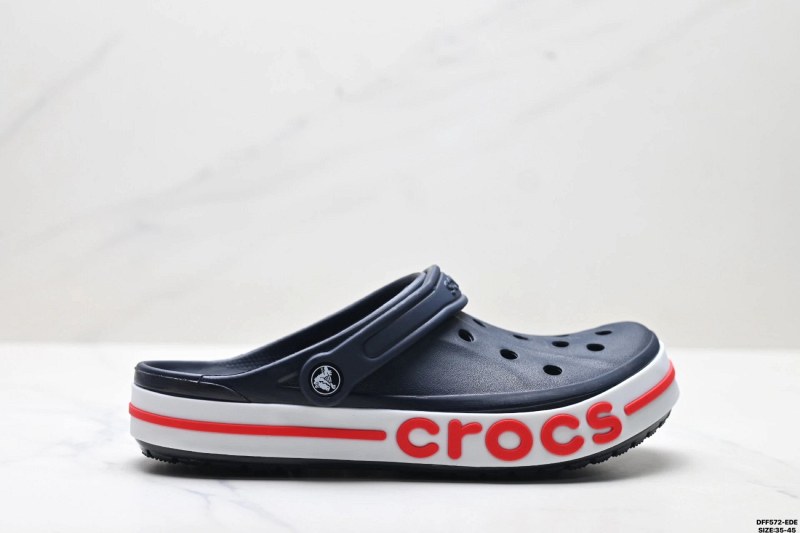
This listing is filed under a name that does not match its own photographs: it is called Crocs Blue Flip-Flops, but the shoe in the images is the Bayaband clog — closed toe, ventilation ports across the upper, pivoting heel strap, dark blue body over a white midsole with a red stripe and oversized red CROCS lettering on the side. Crocs does make a Bayaband Flip; this is not it. Order it expecting a clog and the rest of the listing makes sense. Order it expecting a thong sandal and you will be disappointed before the parcel is even open.
What we ordered and what arrived
We bought two pairs through Litbuy AI, EU 42 and EU 43, at the listed $17.24 (down from $18.74). That price is the item only; agent service fees and international shipping sit on top and are confirmed at checkout, so the delivered cost is higher than the headline figure.
The first order never shipped. Our QC request covers four specific angles — outsole, heel counter, size label and the insole stamp — and the insole stamp frame came back missing. Under our review standard that pair is rejected rather than guessed at, because the footbed stamp is one of the few places a moulded clog tells you what it actually is. We reordered, the second QC set was complete, and the parcel arrived with both pairs bagged, unworn and unmarked.
Measured insole: where the sizing goes wrong
We pulled both insoles, laid them flat and measured length plus width at the ball and at the heel. The numbers explain the conflicting reviews better than any single buyer report does.
| Marked size | Insole length | Width at ball | Width at heel |
|---|---|---|---|
| EU 42 | 26.7 cm | 9.5 cm | 7.7 cm |
| EU 43 | 27.6 cm | 9.8 cm | 7.9 cm |
Those lengths sit at the short end of a standard EU-to-foot-length conversion, and they are measured to the moulded edge, not to a usable wearing line. In practice, a foot that normally takes a 42 with a few millimetres to spare will touch the front of this footbed once the heel strap is rotated back into place. That matches the recurring buyer complaint that toes hit the front in "sport mode," and it matches the fit poll on Crocs' own Bayaband page, where roughly three in ten respondents say the shoe feels small against a very small share who say it feels large. Against that, we also found plenty of buyers insisting the same marked size was far too big and wide, and one Classic-versus-Bayaband comparison reporting the Bayaband runs snug next to a true-to-size Classic. We can only report what our calipers found; the disagreement in the wider record is real and should not be smoothed over.
Six hours of wear
Each pair went through three sessions of two hours or more: one on a hardwood floor, one outdoors on wet pavement and grass, one longer walk through the city. Creasing appeared at the flex point over the toes within the first indoor session and did not deepen noticeably afterwards. Sole wear after six hours was nil beyond light scuffing on the outer heel edge — expected, and not a durability verdict at this mileage. Traction on wet tile was secure; the closed toe kept spray off the foot, which is the practical argument for this shape over an open sandal.
Comfort is firm rather than plush. The footbed has a slight contour under the arch and the foam rebounds slowly when pressed with a thumb, which is the behaviour the authenticity guides describe for Croslite; ordinary EVA tends to stay dented. We would not call it a cloud. The heel strap does its job, and rotated forward it turns the clog into a slide that stays on.
Finish and the checks worth doing on arrival
Moulding is clean: no flash along the midsole seam, ventilation ports punched evenly, and the red side lettering is full and legible rather than shallow. The white midsole paint line is tidy on both pairs. Guides to spotting fakes describe genuine Crocs as single-injection moulded, with full-looking lettering and texture, and advise checking that the sole clearly carries the CROCS mark; that is guide-level description of the material, not something we can certify about this pair beyond the physical checks above. Our insole stamp was present on all four shoes, and the size label matched the marked size each time. If your pair arrives with a soft, dull-edged insole stamp or lettering that reads thin, that is a reason to raise it with the agent before wearing them.
Who this suits, and the caveat that matters
For $17.24 this is a tidy casual clog: eleven sizes from 35 to 45, a colourway that hides scuffs, and a strap system that works both ways. The catch is fit, and it is not a small catch. We cannot hand you a rule of thumb, because the evidence points in two directions at once. What we can hand you is a tape measure: stand on a sheet of paper, mark heel and longest toe, add a centimetre of clearance, and convert that foot length through the EU chart rather than reaching for your usual sneaker size. If you are between sizes, or you cannot exchange a pair that comes up short, this is not the listing to gamble on.