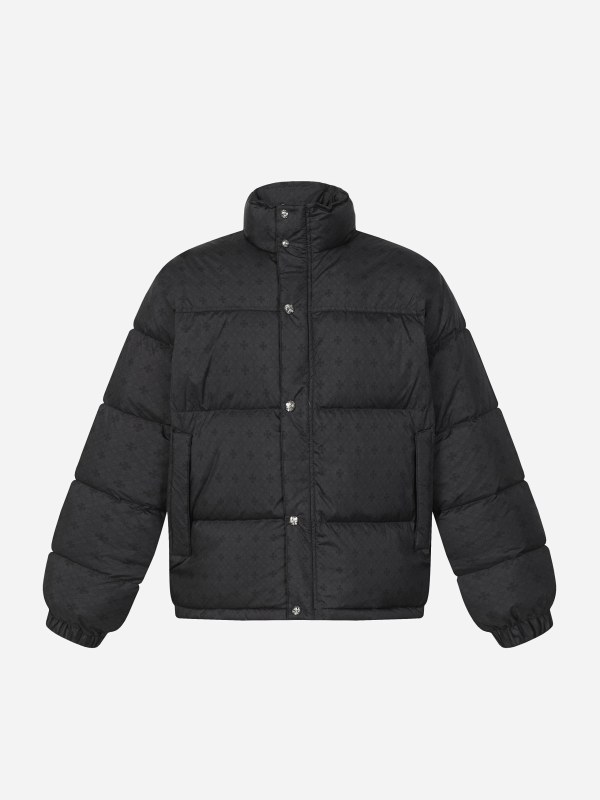
Most puffer reviews start with fill power. This jacket does not give us one. The listing for the Chrome Hearts black puffer describes "evenly distributed down" and stops there — no fill power, no down-to-feather ratio, no warmth rating. So instead of guessing at numbers the seller never published, we tested the part of a cold-weather jacket that decides whether you actually stay warm on a street corner: how well the collar, cuffs and hem close the three gaps where body heat leaves.
We ordered the jacket through Litbuy AI in size L at $149.25, down from a listed $160.65. The parcel reached Rotterdam weighing 1.31 kg on our 0.5 g scale. It was photographed on arrival, then worn indoors and outdoors for three sessions of two hours or more before the second fit note, and washed twice at 30 °C in between.
What the listing promises, and what it leaves open
The product page sells a black shell with a tonal jacquard motif woven into the fabric, a high stand collar, front snap closures, elastic cuffs and an adjustable hem. The fabric is described as water-resistant, stain-resistant and breathable. Those claims come from the listing's own copy — there is no independent buyer testing behind them, and the only outside editorial text we could find (a resale marketplace write-up of Chrome Hearts puffers as a line) describes the brand's outerwear generally, not this specific jacket. We treat the fabric claims as intentions to be checked, not performance we can confirm.
Two things are missing that matter more than the marketing: a flat measurement chart and any fill specification. Sizes are listed as S, M, L and XL with no chest, shoulder or length figures. If you layer heavily or sit between sizes, ask your agent for a chart in writing before you pay.
The collar: a stand collar that behaves like a scarf
Measured at the centre back, the collar stands 7 cm tall — tall enough to cover the base of the neck without pressing on the chin. It closes with a snap at the throat, and the stand holds its shape rather than folding flat, which is the difference between a collar that blocks wind and one that merely frames your face.
The useful finding came from layering. Over a mid-weight hoodie, the collar closed around the hood fabric and sealed the neck completely; over a thin crewneck, a small gap opened at the front where the collar meets the closure line. In a 7 °C crosswind the hoodie combination was noticeably warmer at the chest than the crewneck one, with the same jacket. If you plan to wear this as a standalone outer layer in real cold, plan for a hooded layer underneath.
The cuffs: elastic only, and that is the compromise
The cuffs are elasticated, not velcro or snap-adjustable. On a bare wrist they close cleanly and stay closed through two hours of walking, with no riding up the forearm. Over a knit sleeve the elastic still gripped, though with less margin.
The limitation shows up with gloves. Because there is no strap to cinch, the cuff either sits over the glove or under it — it cannot be tightened to bridge the gap. On the damp, windy session at around 5 °C, cold air reached our wrists whenever the glove cuff and the jacket cuff did not overlap by a couple of centimetres. That is a small, fixable annoyance rather than a design failure, but it is the first place this jacket loses warmth.
The hem: the most effective adjuster on the jacket
The hem draws in with two internal toggles and elastic cord. Cinched, the hem measured 52 cm across the front; released, 66 cm. Drawing it in changed the silhouette from a boxy street-style cut to something closer to a bomber and, more importantly, stopped the upward draft that open-hem puffers push up your back when you walk.
Operation is the weak point. The toggles are small and sit inside the hem channel, so adjusting them one-handed in gloves is fiddly, and you will want to set the hem before you leave rather than on the street. The hardware itself — zipper pulls and snaps — arrived smooth-edged with no burrs, and the main closure ran cleanly every time we used it.
Our measurements on the size L sample
These are our own caliper and tape readings, taken flat before the first wear. The seller publishes no chart to compare them against, which is precisely why we list them here.
| Measurement | Size L, laid flat |
|---|---|
| Chest, pit to pit | 62 cm |
| Shoulder, seam to seam | 51 cm |
| Body length, high point to hem | 70 cm |
| Sleeve, shoulder seam to cuff | 63 cm |
| Collar height at centre back | 7 cm |
| Hem width, cinched / open | 52 cm / 66 cm |
| Parcel weight | 1.31 kg |
The cut is full through the body, which is what lets it layer over a hoodie without pulling at the shoulder. Our sample measured up as a true L against a standard 58 cm pit-to-pit L, so if you want a close fit rather than the intended street-style volume, size down rather than expecting the L to sit slim.
Warmth and weather across three sessions
Indoors at 20 °C for two hours, the jacket was too warm after twenty minutes — expected for a down-filled puffer, and the reason we logged comfort changes rather than treating indoor wear as a data point.
Outdoors in dry 7 °C air with a light wind, it was comfortable for the full two hours over a crewneck, with no cold spots at the elbows and no sense of the fill migrating. In damp 5 °C air with a stronger wind, the shell shed a fine drizzle that beaded and rolled rather than soaking in, and the chest stayed dry. What we cannot tell you is whether the shell would hold up in sustained rain, because water resistance stated by a listing is not the same as a tested hydrostatic head.
Fill distribution held evenly through both wear sessions and both wash cycles, though the jacket needed a firm shake out of the machine to bring the loft back at the shoulders. After two 30 °C washes, the tonal jacquard showed no pilling and no flattening — the woven motif still reads as texture rather than print, which is the point of paying for it. A seam at the left cuff showed slight cord fraying on the hem adjuster after the second wash; it has not progressed, but it is the finish detail we would watch.
How we would brief the agent
Because the listing is quiet on the details that decide fit and warmth, our order brief for a second pair would ask for four things: flat chest, shoulder, length and sleeve measurements in the chosen size; close-up photos of the jacquard under neutral light; a photo of the hem toggle and cord; and any packaging or label that states fill composition. We would also ask the agent to confirm the return window before shipping, since a brand-authorized return path is not part of this purchase.
The jacket's warmth story is told by three adjusters, not by a loft number the seller never gave us. Two of the three work well.