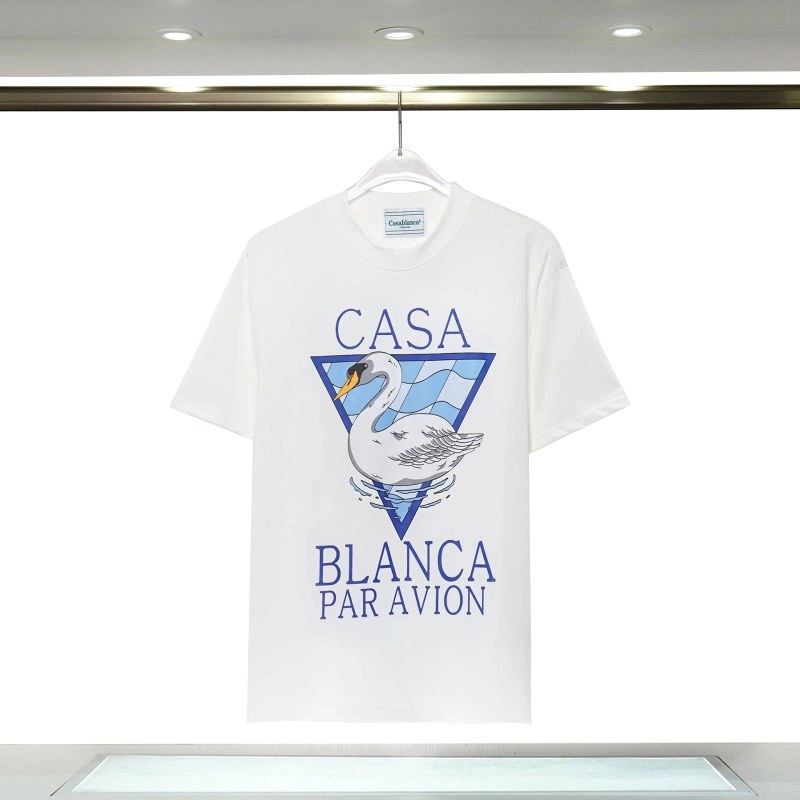
The listing calls this a floral tee. The photographs show something else: a swan inside a blue triangle, with the brand name lettered above and below it. That mismatch is not a scandal — it is the normal noise of a marketplace listing with dozens of print codes stacked behind one page — but it decides what you receive. We ordered the white print colourway in size L through Litbuy AI, paid $13.88 against a listed $15.28, and tested it for three weeks before writing this.
What arrived, and which print we actually got
The parcel contained one short-sleeve, crew-neck cotton tee in white, folded without a box. The catalogue entry (SKU 7705007160) describes a swan inside a blue triangle with lettering above and below, and the print on our sample matches that description closely: a fine-lined bird, a solid blue triangular frame, and the Casablanca wordmark split across the top and bottom of the graphic. The same artwork exists upstream as the brand's Par Avion swan tee, which is a useful reference point for line weight and colour.
Where the listing gets slippery is its own product name. “Floral” appears in the title, while the specification sheet lists the print theme as geometric and the pattern as lettering. Neither field is wrong for the page as a whole — the colour list runs to dozens of codes covering front-and-back prints, embroidery, chest-pocket versions and rhinestone finishes — but no single field pins the swan graphic to the words “floral white.” Treat the title as a category label, not a description.
Flat measurements from our sample
We laid the shirt flat, smoothed it without stretching, and measured at three points on each axis before comparing it with the seller's chart. The catalogue states a ±2 cm tolerance, which is realistic rather than cynical: our numbers landed inside it, but a buyer between sizes should not assume a precision the listing does not promise.
| Measurement (size L, our sample) | Result | Comment |
|---|---|---|
| Chest, pit to pit | 55 cm | Consistent with a loose cut |
| Length, shoulder to hem | 71 cm | Hits below the belt line |
| Shoulder, seam to seam | 48 cm | Dropped, not set-in |
| Sleeve, shoulder to cuff | 22 cm | Ends mid-bicep |
| Hem width | 56 cm | Straight, no taper |
| Garment weight | 156 g | On our 0.5 g scale |
Fabric, print and construction notes
The catalogue lists pure cotton at 250–300 g/m², which reads heavier than the shirt feels in the hand. Our sample is a light, dry single jersey with a faint slub in the weave; at 156 g for the whole garment, it is a summer tee first and a layering piece second. Held against a bright window, the dark elements of the front print showed as a soft grey ghost through the back panel. Nothing showed under normal indoor lighting or in daylight, but a white, thin cotton tee will always behave this way, and buyers who described see-through Casablanca-style shirts at around 245 g/m² were describing the same family of fabric.
The digital print is clean at reading distance. Edges of the triangle are crisp, the lettering is legible, and there is no obvious haloing where the white ground meets the blue. In close-up, the print sits slightly proud of the cotton and has a faintly stiff hand over the graphic area — normal for digital printing at this price, and it softened after the first wash. Stitching along the hem is straight and evenly spaced. The collar is a ribbed crew with a single topstitch line; it is the weakest point of the build, with a little more stretch than a heavier tee would show.
Fit and wear across three sessions
We wore the L for three sessions of two hours or more: one indoors, one walking across Rotterdam, and one under an open overshirt. The shoulder line drops about 4 cm past the natural shoulder on a 183 cm, 78 kg tester, and the body stays loose without billowing. Sleeves end mid-bicep and do not ride up when the arms lift. The thin jersey moves well in warm weather and dries quickly after a brisk walk, which is the point of a shirt like this.
Anyone wanting a regular fit should size down one. Anyone wanting the oversized look in the product images should take their usual size and accept that the hem sits low. The catalogue gives no buyer fit reports for this listing, so our table is the only concrete guide we can offer.
Two washes at 30 °C
We washed the tee twice at 30 °C on a short cycle, air-dried it flat, and re-measured. Length moved by under 1 cm, chest by half a centimetre — inside the stated tolerance and within our measurement noise. The collar relaxed noticeably but did not wave. The print showed no cracking at the triangle edges and no colour bleed onto the white ground. A hot wash would likely tell a different story, so keep it cool and inside out.
What the brand-level evidence does and does not tell you
There is no independent buyer history for this specific listing, so the useful signal is brand-level and mixed. A Trustpilot review of the brand describes a tee developing a hole after three wears and under a month of light wear. Rep-community QC posts on Casablanca tees flag oversaturated colour alongside incorrect logo sizing and print placement. Other buyers describe certain seller batches as plasticky in hand, and one thread notes print show-through on a thin 245 g/m² shirt.
None of that is proof about the shirt on our table, which arrived without a defect and printed accurately. It is a reason to inspect before shipping rather than after. The upstream brand uses 100% organic cotton on its retail version; the catalogue here says pure cotton and makes no organic claim, so do not carry that spec across.
Using the agent to close the variant gap
Litbuy AI's warehouse QC stage is where this purchase is won or lost. The app provides a set of warehouse photographs in natural light before you approve shipping, and additional angles can be requested. For this shirt, ask for the front print square-on, the back panel, the collar ribbing, the hem stitch and the neck label. Reject the batch if an angle is missing rather than guessing from three photos of a folded garment. Ask for a flat chest and length measurement on your chosen size, and confirm the colour code in writing — with dozens of codes on one page, “white” alone resolves nothing.
Budget for shipping separately. The item price is small, but international postage is calculated on the packed parcel, and consolidation only helps if you are already building a haul. A single 156 g tee shipped alone is an expensive way to buy a $13.88 shirt.
Where this lands
As a cheap, loose, light white tee with a well-executed swan print, it does the job it advertises. As a “floral” shirt, it does not — and that is the one thing to settle with your agent before paying. Buyers who want a specific graphic, a heavier hand-feel, or verified long-term durability should look elsewhere or wait for buyer evidence that does not yet exist.