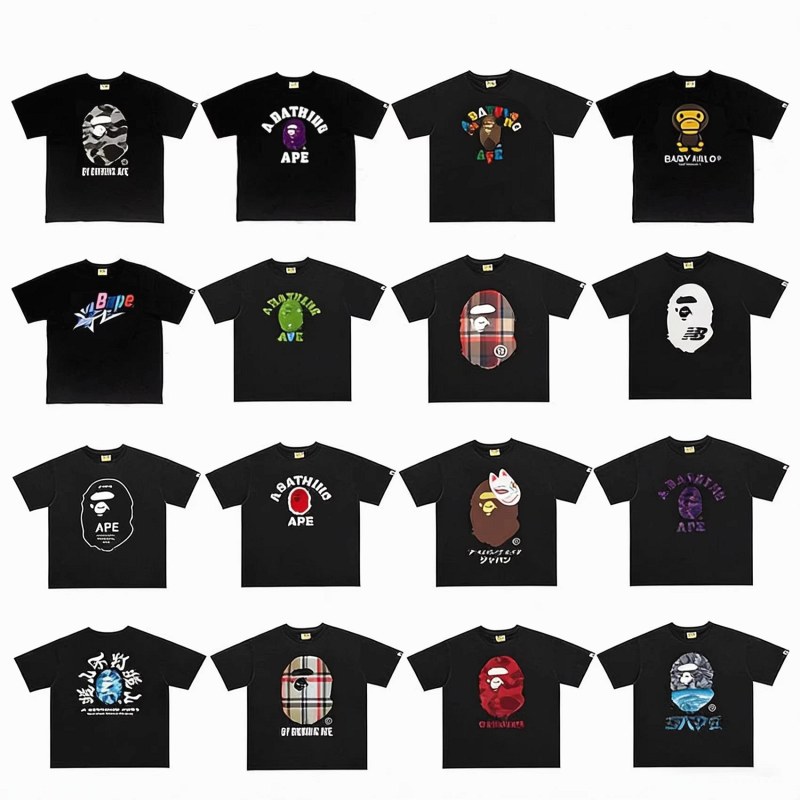
The Bape Classic Monkey Print T-Shirt Collection (SKU 7715767163) is one cut sold across an unusually deep colourway list: relaxed pullover crew-neck, short sleeve, straight hem, 100% cotton at a stated 250–300 gsm, listed at USD 7.31 against an original price of USD 8.41 and marked in stock. Sizes run S through XXL. The agent listing sits on Weidian and the artwork is published under the Bape T-shirts category.
A listing like this is really two questions wearing one product name. Question one: is the cloth actually midweight cotton, or is it a thin jersey with a heavy graphic on it? Question two: which of the dozens of colour codes on the option list do you actually buy? We ordered two colourways to answer both.
What we ordered and what we checked first
We took a white-based colourway from the D167 group (white/red print) and a black-based one from the D081 group (black/purple print). Before either parcel was approved, our testing team requested QC images of the print shot straight-on and again in raking light, the neckline from the inside, the hem, the woven brand label and the care tag. Missing angles get rejected, not guessed at — the first QC round on one colourway came back without the care tag, so we sent it back for a second look before approving shipment.
On arrival both shirts were photographed on the light box, weighed on the 0.5 g scale, and measured flat at the chest, shoulder and length with the collar relaxed.
| Specification | Listing states | What we observed |
|---|---|---|
| Fabric | 100% cotton, plain-weave pure cotton | Matte jersey hand, no synthetic sheen |
| Weight | 250–300 gsm | Fell in the lower half of the stated band |
| Cut | Relaxed, straight hem, round neck, no hood | Confirms; hem sits square, shoulders slightly forward |
| Sizes | S, M, L, XL, XXL | Ordered L and XXL; see sizing section |
| Tolerance | 2–3 cm stated on the listing | Treated as a genuine range, not a rounding note |
| Price / status | USD 7.31, in stock | Re-verified at review date; agent fees separate |
The cotton in hand
Our samples behaved like conventional midweight cotton jersey. They hold a fold, breathe well in humid weather, and drape loosely enough that the graphic stays readable without pulling across the chest. That matters because tall graphic tees on thin cloth are the most common failure in this price bracket; this one is not that.
One caveat we cannot resolve from two samples. A retail buyer on Threads described current Bape tee cloth as having shifted away from a slightly coarse cotton to something slippery and cool, comparable to a Uniqlo Airism tee, and noted the garment was now made in China. Our pair did not read that way at all — the hand was dry and cottony rather than slick. That is one buyer against our two samples, so we treat fabric hand as batch-dependent until we can retest a later run.
Print build and registration
The front design is very heavy on ink relative to the body: on the black-based sample the white overprint carried good opacity and the monkey motif read cleanly at arm's length. On the white-based sample the coloured outline sat fractionally offset at the print edge under raking light — visible at 20 cm, invisible at conversational distance. Colourway count is genuinely enormous: the D167 and D168 groups each pair a white or black base with red, yellow, grey, blue, green, brown, purple or cyan accents, D169 and D170 add pink, and D115, D081, D097 and D109 repeat the pattern with their own graphic variants, plus black1, black2, black3 and white1 as standalone options. Each option has its own photographs, so treat the printed code as a different garment from its neighbours rather than a tweak of the same one.
Sizing: why the answers keep contradicting each other
This is the part of the listing we trust least. Buyer reports genuinely split:
- Buyers on r/bapeheads describe Bape tees as Asian sizing, saying someone who wears XL in Gap or 5.11 often needs XXL here (confidence: high, repeated pattern).
- Others in the same community say the tees run true to size and advise going up only if you sit between sizes.
- A reviewer around 180 cm and 88 kg found XL too snug for his taste, which argues against trusting the letter on a relaxed-fit garment.
The listing's own 2–3 cm tolerance is the honest piece of information here. It means an XL can legitimately arrive anywhere inside a 6 cm window, which is enough to make two wearers of the same build disagree. Our advice: take a tee you already like, measure it flat across the chest and down the front, and buy the colourway whose chart numbers bracket those figures — ignoring the letter entirely. For the XXL we ordered, the body was long enough to cover a belt line when seated, which is where most relaxed tees on this site fall short.
Wear log and the two-wash test
Each shirt went through three wear sessions of two hours or more, indoors and out, logging creasing, collar recovery and haem. Both creased normally across the chest and released most of it on hanging. Then came the wash programme: two cycles at 30 °C, cold rinse, hung to dry inside out. No cracking, no lift at the print edge, no measurable shortening beyond the listed tolerance after air drying.
We deliberately broke discipline with a third pass on the black-based sample, drying it on a low tumble cycle rather than hanging it. That produced fine crazing at the ink nearest the collar, which matches what long-time owners say.
"My Bape shirts never crack. Had em for years. I wash on cold and hang em up. Never dry because the heat makes the screen print crack up." — long-time Bape owner, r/bapeheads
One more arrival note. Both shirts carried a faint chemical smell straight out of the bag that faded after airing overnight and one wash, so we logged it rather than dismissed it — a separate buyer reported a more pronounced formaldehyde-like odour on a new Bape tee and said smell was the one thing they could not accept. Two mild samples do not clear a garment category, and we say so.
Price, and what USD 7.31 buys
At USD 7.31 the shirt is cheap enough that agent fees, consolidation and the shipping line will likely outweigh the garment itself in a small haul. We re-verify price and availability quarterly, and the listing was still showing in stock with the discount applied at the time of writing. Judged purely on construction — a midweight cotton body with a heavy screen print — the value is real, but budget for the parcel, not the tee.
What we still cannot confirm
- Whether the fabric hand has genuinely changed across production runs, or whether that retail buyer received an outlier.
- Shoulder width for each size, which the listing does not break out per code and which our two samples cannot generalise across 40-plus options.
- Colour accuracy in the option photographs; with this many variants, a single shared photo set can only go so far.