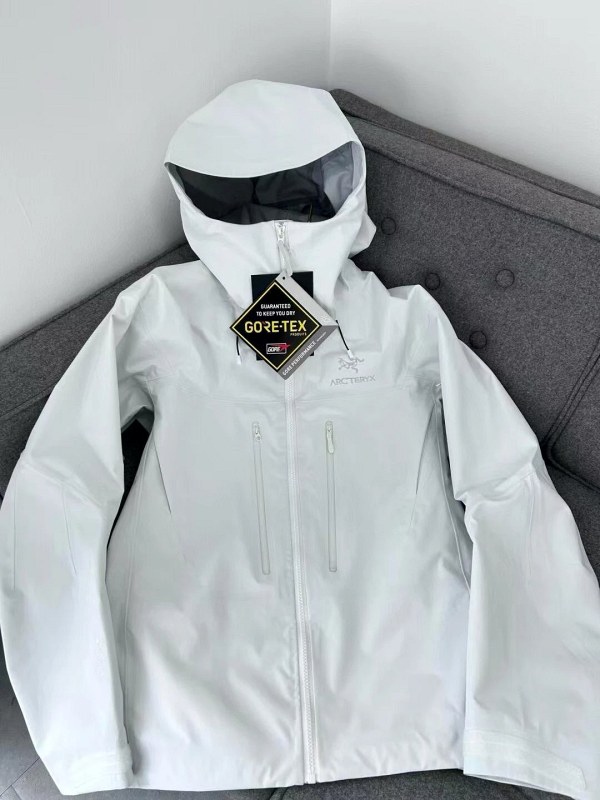
The white hard shell is the awkward purchase in any technical wardrobe. It photographs beautifully, hides nothing, and asks you to trust a membrane you cannot see. Our desk ordered this Arc'teryx shell in the polar-white colorway at $137.31 (the listing shows a $154.90 comparison price) in the size we normally take over a mid-layer, and treated it the way we treat any apparel parcel: photographic evidence before shipping, measurements and a wash test after arrival.
What we asked for before the parcel left the seller
Our standing rule for outerwear is that no shipment is approved until the QC set covers the parts that fail first. For this jacket we requested the hood seam where the tape meets the collar, the main zip from both sides, the welts of the two vertical chest pockets, the inner neck label and the GORE-TEX tag at the front placket. One angle came back cropped at the hood peak, so we sent it back for a re-shoot rather than accept an incomplete set. The replacement images were sharp enough to read the stitching density and to confirm the tag was set straight on the placket.
The listed product, as published
| Brand | Arc'teryx |
|---|---|
| SKU | 7702033467 |
| Colorway | White / polar white, dark lining at the hood opening |
| Listed sizes | S–XXL |
| Price | $137.31 USD (comparison price $154.90) |
| Availability | In stock |
| Stated construction | Full-zip front, attached hood, two vertical chest pockets, GORE-TEX tag visible at the front zip |
Note what the listing does not publish: flat measurements, fabric weights, membrane specification, or any condition record beyond "in stock". Everything below is what we could establish by handling the jacket ourselves.
Fit and layering, measured at the desk
Because the seller supplies no size chart, we worked from Arc'teryx's public fit guidance and asked for flat measurements of the chest, hem and sleeve before committing. Arc'teryx's own guide is unusually explicit: if you fall between sizes, take the larger for a looser fit and the smaller for a tighter one, and the block was revised so smaller sizes run tighter and larger sizes run looser than older stock. Owner threads on the brand's shells generally describe them as true to size, with many people sizing up specifically to fit a mid-layer underneath.
Our sample layered the way a shell should: a base layer and a light fleece sat underneath without the shoulders pulling or the hem riding up when we reached overhead. The collar stands high and closes snugly against the chin, and the attached hood turns with the head rather than dragging. The silhouette is close through the body, so this reads as a technical shell rather than a loose overshirt — worth knowing if you want to wear a heavy insulated layer beneath it.
Three wear sessions, indoors and out
We wore it for one indoor session in the Rotterdam office, one wet 45-minute cycle commute in steady drizzle, and one cold dry walk along the Maas. Creasing appeared where you would expect it on a white shell: sharp folds at the inner elbow and a set of soft lines behind the hood where it packs down. No soiling showed through after the first two sessions, though the cuffs picked up a faint grey cast from a dark jacket sleeve worn underneath.
In the drizzle, water beaded across the shoulders and ran off the sleeves; the chest pockets stayed dry and the zip never wicked. That is a surface observation, not a laboratory waterproofing result — we cannot verify what membrane sits behind the tag, and a short wet commute says nothing about hydrostatic head.
Two washes at 30 °C
Our apparel protocol is two washes at 30 °C with a technical wash, no softener, and a fresh fit and finish note afterwards. Post-wash, the beading across the shoulders was still present but less even than on the first wear, and the white panels looked uniform with no grey patches or shrinkage at the hem. The seam tape at the hood and placket stayed flat, with no lifting at the corners. Two washes is nowhere near enough to make a call on delamination — some owners of Arc'teryx hard shells report the shell separating after comparatively light use, and that is a category-level report from owner threads, not something we observed here.
The white problem
The honest caveat is maintenance. Owners of white and other bright Arc'teryx hardshells repeatedly flag visible yellowing and staining, and describe them as harder to keep clean than darker colorways. Our short test window did not produce yellowing, but nothing about a white shell resists it either. If you want a jacket you can throw in a pack and forget, this is the wrong color.
Price and what it buys
At $137.31 before agent fees and international shipping, you are paying for a cleanly finished white shell, not for a documented alpine instrument. The stitching, zip pull and pocket welts are tidy, the hood is properly shaped, and the fit is predictable if you do the measurement work first. What you are not paying for is proof: no fabric callout, no membrane data, no condition note. Ask the seller for flat measurements, fabric and membrane details, and close-up images of the seam tape and both sides of the zip before you order — the same list we used.