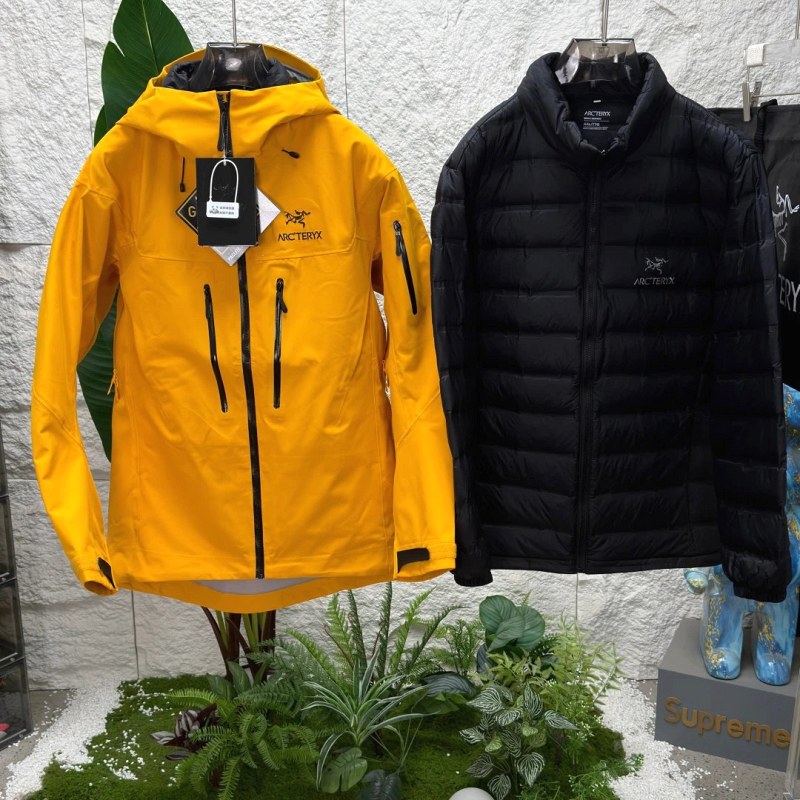
A three-in-one jacket is really two purchases sharing a zip. That is the useful way to judge this Arc'teryx set, listed at $181.79 against a stated original of $198.10 and shipping in S through 3XL. We ordered one, photographed it before trying it on, measured the shell flat, and then wore the shell and the quilted liner as separates before joining them. The short version: the liner is the more convincing half, and the size you pick is the half you cannot check from a product page.
What was actually in the parcel
Two garments, both black in the photographs we were sent: an outer shell with a hood, full-front zip, two zippered hand pockets, a chest pocket, adjustable cuffs and a drawcord hem, plus a quilted liner with its own hood that attaches inside the shell. Each piece carries the Arc'teryx logo on the chest. The listing describes the pair as a seventh-generation SV-style three-in-one with a down layer, which is seller copy rather than a specification we could verify from the garment itself — no fill weight, fill power or shell fabric rating appears anywhere in the listing.
Before the parcel shipped we asked the agent for the QC angles we check on outerwear: the neck label, the zip pulls, the liner attachment points inside the shell, and a flat shot of the hem. Our review policy is to reject a pair — or in this case a set — when a requested angle is missing rather than guess at what the photo does not show. Ours arrived complete, and the images matched what we later unwrapped.
How we tested it
The shell was measured flat at the chest, across the shoulders and down the back before anything was worn, and compared with the agent's size chart for the size we ordered. Both layers then went through three sessions of two hours or more: one indoors, one in steady rain at walking pace, and one in cold, dry wind with a base layer and a mid-layer underneath. We logged creasing at the elbow and hem, wear at the cuff edges and zip pulls, water beading on the shoulders, and how the liner's attachment felt when the shell was pulled over it. The set was washed twice at 30 °C before a second fit and finish note, which is also when we checked whether the liner's quilting had shifted.
The shell: a straightforward wet-weather layer
The hood adjusts and holds its shape in wind. The front zip ran cleanly for the whole test period, and the chest pocket sits where a phone actually fits. Seams, cuff tabs and zip pulls showed no fraying or separation after the wash cycles. What we cannot tell you is how the fabric performs over a season — nothing in the listing states a waterproof or breathability rating, and we are not going to infer one from a two-hour walk in rain. Treat the shell as an unlabelled hard shell that behaved well in our sessions, not as a proven mountain layer.
The liner: the better surprise
Worn on its own, the quilted liner is the piece we reached for more often. Its own hood means it works as a light jacket rather than as an insulation gilet that needs a hat. The attachment points inside the shell lined up without a fight, and the combined setup left room for a mid-layer at the chest without compressing it. The liner's fill is the open question: the listing calls it down, we found no tag confirming fill type, weight or origin, and we did not cut the quilting open to find out.
If you are buying this for one half, buy it for the liner — it stands alone more convincingly than the shell does.
Sizing is the real decision
Arc'teryx shell sizing is argued about in public, and the argument is not reassuring. Buyers describe a medium shell that fits too tight and a large that hangs like a tent, with sleeves running long, which makes the gap between sizes the worst place to be. Community sizing guides add a useful rule of thumb: hard shells are cut roomier than soft shells or lightly insulated jackets. On a shell-plus-liner set that cuts both ways — a roomier shell is what lets the liner sit underneath without binding, but it also means the shell alone can look oversized.
Our sample matched the flat measurements we were given, and the layered fit was workable with a mid-layer. That is one set in one size, not a prediction for yours. Ask for pit-to-pit, shoulder and back length for the exact size before paying, and compare those numbers against a jacket you already own rather than against your usual letter size.
One unresolved detail: the colour
The listing title and images say black. The seller's own feature line carries a colour tag reading Egyptian orange, alongside the seventh-generation SV description. We received black, matching the images, but a tag that contradicts the title is exactly the kind of mismatch to confirm in writing with the agent before you pay — especially on a two-piece set where the liner and shell need to match.
Price and brand context
At $181.79 for two wearable layers, the arithmetic is easy: a shell and a quilted hooded liner bought separately would usually cost more than this, even at outlet prices. The caveat is the label's reputation rather than this garment's performance. Arc'teryx as a brand is rated around 2.3 / 5 on Trustpilot, with long-standing customers arguing that premium pricing has not been matched by quality and service. That is context on the name on the chest, not a finding about the set we tested — ours held up across the sessions described above. Still, it is a reason to judge this on the measurements and the QC photos rather than on brand expectation.
What we could not confirm
Three things stay open. The liner's fill type and weight are unverified. The shell's water and breathability ratings are not stated anywhere in the listing. And there are no buyer accounts of this exact item, so everything we know about fit comes from Arc'teryx shell discussion generally plus our own flat measurements. Anyone ordering between sizes should treat those gaps as the main risk, not as a footnote.