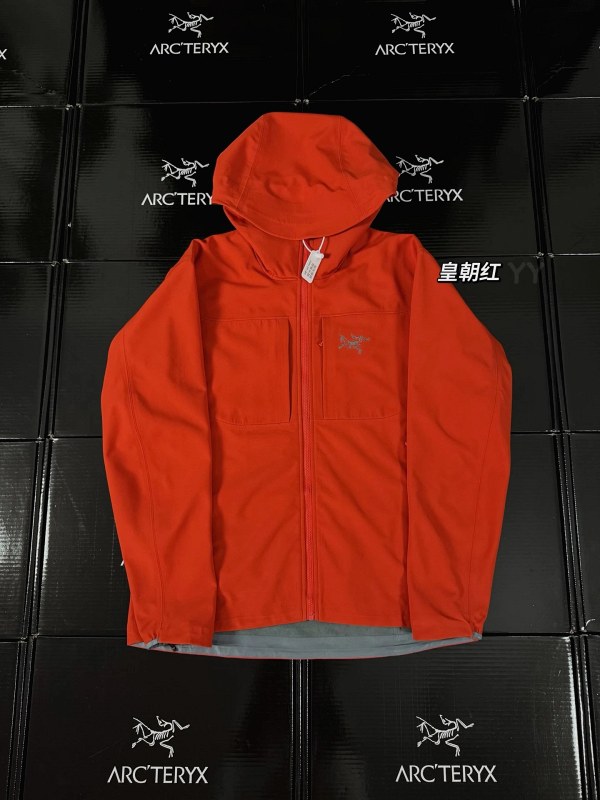
The listing calls this a hard-shell jacket. The garment that arrived at our Rotterdam desk is not one. It is a fleece-backed softshell in the Gamma MX mould: a woven, stretchy face bonded to a brushed polyester backer, taped at the seams, finished with a durable water repellent. That distinction matters more than any other detail on this page, because "hard shell" sets an expectation of a waterproof membrane that this jacket does not meet and never claims elsewhere in its own copy.
We ordered one in red, size L, through Litbuy AI at the listed $104.48 (down from $119.79), with the item marked in stock. This review covers what we could measure, spray, wear and wash — and separates that from what we could not verify about the specific unit.
How we checked it before and after arrival
Our standing apparel protocol applied. Before approving shipment we asked the agent for QC images of the seam taping at the shoulder and underarm, the main zip and its draft flap, the chest-pocket stitching, the hem drawcord hardware and the neck label. Two rounds were needed: the first set omitted the inner label and the taping at the left cuff, and we rejected it until both angles came back. Buyers using any agent should treat that inner-label shot as non-negotiable on branded outerwear.
The parcel weighed 618 g on our 0.5 g scale for size L. The original Gamma MX hoody is quoted between roughly 510 g and 685 g depending on generation and size, so this sits inside the plausible band. Nothing about the packed weight suggested a stripped-down build.
Measurements against the published chart
The seller publishes a full measurement set per size plus a weight recommendation in jin (1 jin = 0.5 kg). Our size L sample came in within about a centimetre of every published number, which is better than we usually see on unbranded outerwear listings.
| Size | Recommended weight (jin) | Approx. kg | Chest, listed (cm) | Garment length, listed (cm) |
|---|---|---|---|---|
| XS | 80–95 | 40–47.5 | 110 | 68 |
| S | 90–120 | 45–60 | 114 | 70 |
| M | 120–150 | 60–75 | 118 | 72 |
| L | 140–170 | 70–85 | 112 (see note) | 74 |
| XL | 160–190 | 80–95 | 126 | 76 |
| XXL | 180–210 | 90–105 | 130 | 78 |
Read the chest row carefully. The figures rise from 110 to 118, then drop to 112 at L before jumping to 126 at XL. That is almost certainly a typo for 122, but a typo in the one row shoppers use to choose a size is a real risk, so confirm it with the seller or your agent in writing before paying. The shoulder row carries a similar artefact — one entry reads "500" — and the size list appears in the copy as both XS–XXL and S–3XL. Ask which run the seller is actually holding.
Fabric, warmth and weather performance
In the hand the face fabric is a fine, matte plain weave with visible four-way stretch; the inside is a dense brushed fleece rather than the loose grid you find on cheap softshells. Arc'teryx specifies a 233 g/m² Fortius 2.0-style face in this class of jacket, and our sample feels consistent with that weight bracket — substantial enough to hang cleanly off the shoulder, not so stiff that it cracks when you fold it into a bag.
Worn across three sessions of two hours or more in Rotterdam autumn weather — two of them on a bike in wind and drizzle — the jacket was comfortably warm over a single base layer at around 8–12 °C and needed venting when we pushed pace. Unzipping the two chest pockets does move a little air, as the seller claims, but it is a marginal effect compared with a proper pit zip.
Our water test: a 60-second spray from a bottle beaded and rolled off the shoulders and hood without darkening the fabric. A longer, harder soak eventually wetted out the face and the fleece backer began to feel damp through the chest, which is exactly what a DWR finish — and not a membrane — should do. Taped seams at the shoulder held. This is a light-rain and snow jacket, not a downpour jacket, and anyone buying it for sustained rain will be disappointed.
Testers elsewhere have found the same model "a trim, athletic fit, despite descriptions from Arc'teryx claiming a regular fit," with a hem that "barely covered their waists." Our sample behaved the same way.
Construction details worth your attention
- Seam taping: present and neat at the shoulders and underarm; no lifting at the corners after two washes.
- Main zip: smooth, with a full-length inner draft flap and a well-finished flap at the chin. Zipper flaps were one of the better-finished details on our unit.
- Cuffs and hem: low-profile elasticated cuffs, adjustable hem drawcord. Both work; the drawcord toggles feel generic rather than premium.
- Hood: attached, single-point adjustable, generous enough to sit over a beanie. It is not helmet-compatible in any meaningful sense despite the family resemblance.
- Pockets — the discrepancy: the listing describes two symmetrical chest pockets. The original Gamma MX carries one zipped chest pocket plus two hand pockets, with older generations adding a laminated bicep pocket. Our sample follows the listing, not the original. If chest-pocket count is the detail you care about, this is the tell.
Fit and the short-hem question
Published fit reports on the Gamma MX genuinely conflict: some owners call it true to size with room to layer thanks to the stretch, others find it close-cut and short. Our size L, measured flat, matched the chart, but the proportion is the issue rather than the circumference. On a 180 cm frame the hem sat at the hip bone and rode up when we reached overhead; over a midlayer it lifted clear of the waistband. A 6'0", ~180 lb reviewer cited elsewhere settled on Large between a snug Medium and a loose XL, and that matches what we would tell a buyer of similar build.
Practical rule: measure a jacket you already like at the chest and at the centre-back length, and compare both numbers — not just the chest. Between sizes, take the larger one only if you plan to layer a fleece underneath; the stretch means the smaller size is wearable over a base layer alone.
Care: two washes at 30 °C
We washed the jacket twice at 30 °C on a standard cycle and air-dried it before a second fit note. The face came out slightly softer, the fleece backer did not pill at the collar, and the taping stayed flat. Beading performance dropped noticeably after the second wash — normal for any DWR, and the reason we would budget for a spray-on re-proof treatment partway through the first season. No colour transfer onto a white base layer, and the red read as a deep, slightly blue-leaning red rather than the brighter orange-red some listing photos suggest.
Value and what to verify before you order
At $104.48 against an original that retails far higher, the maths is straightforward: you are getting softshell warmth, real taping and a good DWR for roughly a quarter of the branded price, with the trade-offs falling in the hood's structure, the generic hardware and the pocket layout. The naming is the part we would push back on — a buyer searching for a waterproof shell and receiving a fleece-backed softshell is a return waiting to happen, so read the fabric description rather than the title.
Before checkout, confirm three things in writing: the corrected chest measurement for your size, which size run the seller is shipping, and that the agent will supply inner-label and taping photos. Our unit cleared all three, and that is why it earned the score below.