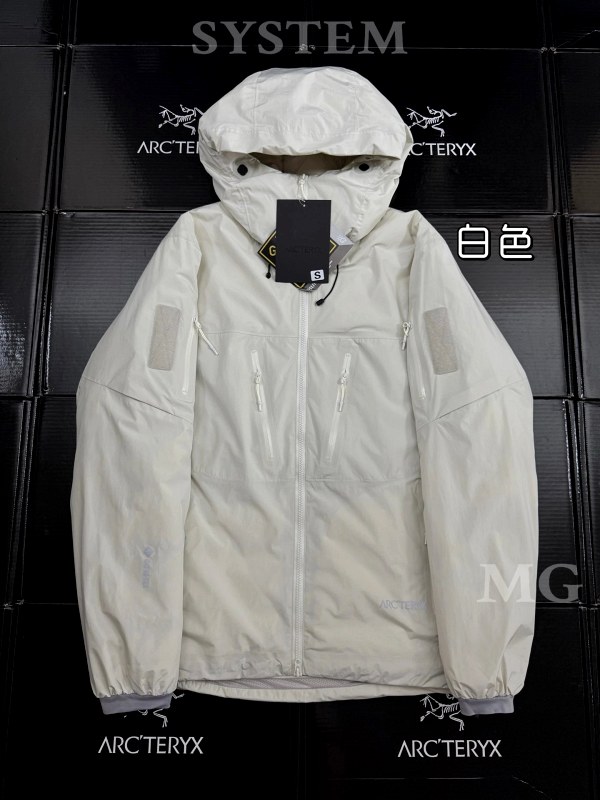
We ordered the Arc'teryx Kobah Parka Hard-Shell Down Jacket in polar white, size M, SKU 7702084767, at $181.79 against a listed $212.44. It arrived through Litbuy AI in the oversized gift box the listing advertises. Because the parka is sold as a hard shell with down inside, we treated it as two separate questions: does the shell keep weather out, and can the insulation be verified? Only the first one closed cleanly.
The QC angles we asked for, and the one that never came
Before approving shipment we request specific photographs of any garment. For a hard shell that means the outer face, the hood seam viewed from the inside, the sleeve patch, the chest logo, both ends of the main zip and any label or care tag. All but one arrived. The label shot we asked for twice never appeared, and the parcel itself carried no fill label and no care label that we could locate on the shell, the lining or inside the pockets.
Everything else matched the photos we approved: the pale face fabric, the straight hem, the elastic cuffs, the rectangular sleeve patches and the low-contrast hardware. Nothing about the delivered jacket contradicted the approved images.
Bench numbers before anything was worn
The listing carries no meaningful shipping weight, so our 0.5 g scale did the work. We photographed the parcel sealed, then opened it and weighed the parka on its own.
| Measurement | Our result (size M) |
|---|---|
| Parcel weight, gift box and mailer included | 1,340 g |
| Parka alone | 1,180 g |
| Chest, flat, pit to pit | 66 cm |
| Sleeve, shoulder seam to cuff | 66 cm |
| Back length, collar seam to hem | 78 cm |
| Hem width, flat | 68 cm |
That is a genuinely oversized body. The chest and shoulders swallow a midweight fleece without compressing anything, which is what the cut promises. The sleeve number is the one that matters: at 66 cm the cuff reached past the knuckle on our tester, and it bunched inside a glove.
Two washes at 30 °C
Our apparel protocol is two 30 °C washes before a second fit and finish note. With no care label to follow, we chose the most conservative cycle we could justify: gentle technical programme, 30 °C, low spin, no softener, a liquid technical wash, then a low tumble dry with dryer balls.
After the first wash, water still beaded and rolled off the shoulders and hood. After the second, beading was visibly weaker and the face fabric wetted out slowly across the shoulders before the shell dried. A ten-minute shower test on the hung parka produced no water on the inner face at the hood seam or the shoulder seams, and no bubbling or lifting of the seam tape under the light box. The insulation clumped while wet, recovered most of its loft after drying, and felt marginally thinner at the elbows than it had out of the box. Without a care label, treat our cycle as a data point rather than an instruction.
Hardware and hands
We cycled each YKK 5VST zip 60 times. The main zip ran smoothly with no snag or skipped tooth, and the waterproof finish on the tape did not crack. The laser-cut cord locks adjusted the hood one-handed with a glove on, which is more than we can say for most hood hardware at this price. The chest logo, hood branding and sleeve patches sat straight under the light box, and the stitching along the hem and cuffs was even.
Three sessions in it
Two indoor sessions at roughly 12 °C over a midweight fleece, and one outdoor session at 3 °C with wind. Indoors we overheated inside 40 minutes and had to open the main zip; this is a shell that traps heat rather than venting it, so it is not a jacket for a warm shop or a packed train. Outdoors the wind stayed out, the hood held its shape, and the cuffs sealed against a glove.
On fit, the body is forgiving but the sleeve is not. If you are between sizes and want a shorter sleeve, do not assume the oversized body means you should size up.
The spec sheet we could not close
The listing stacks five insulation claims: 850 fill-power white down, 450 g of fill, 800 fill power, Coreloft and Polartec Power Air. Elsewhere the same product is described with a blue GORE-TEX hangtag implying a three-layer composite, while the listing's own description specifies a 2-layer 40D face. Size ranges differ too: S–3XL in one place, stopping at 2XL in another seller's chart. Colour names drift between black, Jupiter purple, crystal black and polar white here, and black and grey elsewhere.
None of that changed how the parka performed on our bench. It does mean the warmth figure is a claim rather than a measurement, and we will not present it as confirmed.
Price and what the number covers
$181.79 against a $212.44 list is the catalogue's own reduction, and prices in this category move. What the money demonstrably buys is a sealed 2-layer shell with good zips, tidy finishing and a roomy cut. Shipping, agent fees and any return cost sit outside that figure, and the gift box adds parcel weight without adding warmth.
Before you order
- Ask for a photo of the fill label and care label on the exact colourway and size you are buying, and hold the order if the seller will not send one.
- Measure the sleeve on a jacket you already own. Body width is forgiving; sleeve length is where this parka bit us.
- Confirm the size range with the seller, since S–3XL and S–2XL both circulate for this model.
- Plan for a cold-weather shell worn over a fleece, not a standalone sub-zero parka.