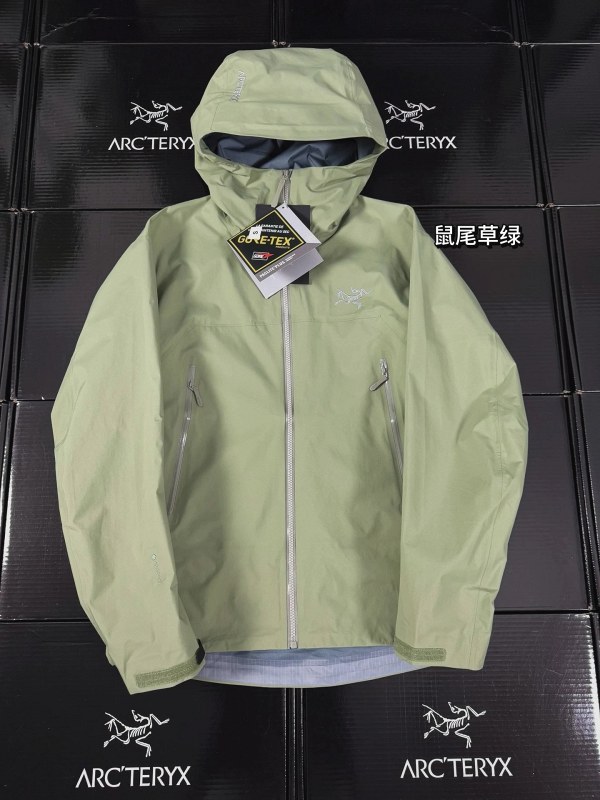
Arc'teryx's Beta Lightweight is the shell people buy when they want three-layer protection without the weight of a mountaineering jacket. This listing offers that silhouette in a single solid light green at $141.04 USD, down from $159.65, and it arrived at the desk in a plain poly bag with no hangtag or care booklet. We ordered it the way any reader would, had the warehouse photograph the chest logo, cuff tape and main zip before it shipped, then measured and wore it ourselves.
What arrived, and what the tape measure said
The parcel weighed less than the tracking page implied, and the jacket itself is genuinely light for a hooded shell. Laid flat and measured at three points, a size M gave a 58 cm chest across the front, a 62 cm back length from the collar seam and a 66 cm sleeve measured from the shoulder point. Those numbers sit close to the published Beta Lightweight block, with the back length landing at the hip rather than the waist — useful when you are cycling in rain and want coverage under a backpack belt.
Finishing is where a $141 shell usually announces itself. Here the seam tape is narrow and lies flat, the chest logo is applied cleanly with no lifting at the edges, and the cuff hook-and-loop tabs are stitched straight. The main front zip is a chunky VISLON-type slider that runs without snagging, and both underarm vents have two-way pulls so you can crack them open from either end. We checked every zip under the light box before wearing: no skipped teeth, no frayed tape.
Fit: keep your normal size, and supply your height and weight
Our tester is 181 cm and 78 kg and wore the medium over a baselayer and a light fleece with room to spare, without the fabric bunching across the chest. The articulated sleeves are the detail that matters most day to day — reaching for a bike handlebar or a railing produces almost no hem lift. The high collar closes snugly under the chin, and the StormHood-style hood has a wire brim plus rear and side adjustment that stayed put in gusts.
Two cautions. First, the listing asks buyers to state height and weight at checkout, and we would not skip that step; the size run is also inconsistent between line items, showing XS–XXL in one place and S–3XL in another. Confirm which run applies before you pay. Second, if you are between sizes, the fit threads we reviewed lean strongly against sizing up in an Arc'teryx hardshell — most owners keep their normal size or step down a size, and a shell that is too big loses the drape that makes this pattern work.
How the light green reads in daylight
Photographs of pale green shells are unreliable, so this was the first thing we checked in the open. In overcast Rotterdam light the colour is a soft, chalky green with a matte face — closer to a washed sage than the vivid mint some listing images suggest. There is no colour shift between the body, hood and sleeves, and the tone stays consistent in flat light and under a grey sky. It marks more readily than black or navy, particularly at the cuffs, and the matte face shows dried rain spotting until you wipe it down. If you want a shell that looks the same after a muddy commute, choose a darker colourway; if you want the exact light green shown, the delivered jacket matches the listing photography closely.
Three sessions of wet, windy weather
We wore it for two hours indoors to check for stiffness and noise, then for two outdoor sessions of two hours each: one in steady drizzle with a 40 km/h crosswind, one in a heavier shower with a loaded backpack. Wind is the easy part — nothing passes through the body panel, and the hood brim keeps rain off glasses. Water beaded and ran off the shoulders and hood throughout both sessions, and the chest and pocket contents stayed dry.
The hood and pit zips earned their place. Opening both underarm vents during a fast walk shed heat within a couple of minutes, and the two-way pulls work with gloves on, which is more than we can say for the hood's side adjusters, which need a firm pinch. After the backpack session we found light abrasion fuzz on the shoulder where the strap sits — cosmetic at this stage, but worth watching if you carry a pack daily.
Two things we cannot confirm. The listing names both N40L GORE-TEX with a tricot backer and Tri-Durance fabric in the same description, and there are no independent buyer reports for this exact listing. Ours performed like a three-layer waterproof shell in rain and wind, but we are not going to call the membrane on the basis of two wet afternoons. Ask the seller to confirm the fabric specification in writing before ordering, so a return is straightforward if the delivered item does not match.
Maintenance and what $141 buys you
Owners of the real Beta line are blunt about longevity: a hard-used GORE-TEX shell can wear out in a few years rather than a decade, and regular washing is part of ownership, not an optional extra. Treat this jacket the same way. Wash it with a technical detergent, tumble it low to reactivate the water-repellent finish, and expect to reproof the shoulders and hood after a season of commuting. At this price, a shell that survives three wet winters works out cheaply; a shell that delaminates in year two does not, and that risk is the honest trade-off you accept at a fifth of retail.
What we would ask the seller before ordering
- Confirm the fabric wording — N40L GORE-TEX or Tri-Durance — and whether the backer is tricot.
- Confirm which size run applies to this colourway, and give height and weight at checkout.
- Request QC photos of the chest logo, cuff tabs and both underarm zips before the parcel leaves the warehouse.
Our full method applies: this pair-free garment was measured flat at three points, worn indoors and out for more than six hours total, and photographed on arrival before use. It stays on the shelf sealed for twelve months, so if anything above is disputed, we can re-open and re-measure the parcel.