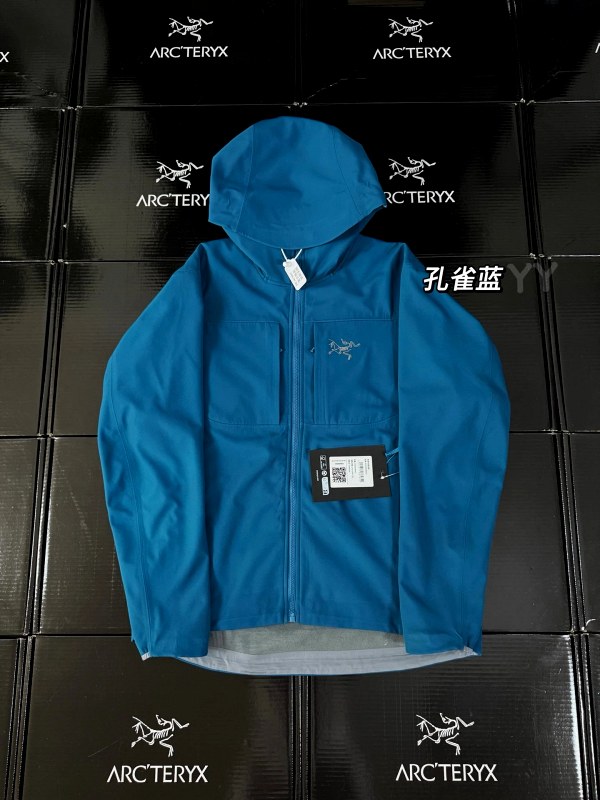
The listing title says hard-shell. The listing's own specification text says something else: a Gamma MX-style softshell with a thin fleece backer, Fortius-style face fabric and a DWR finish. We ordered the blue version at $104.48 (down from $110.08, in stock at the time of writing), had the parcel photographed in the warehouse, weighed it on the desk scale and put it through three outdoor sessions in Rotterdam weather before washing it twice at 30 °C. The short version: the jacket is the more useful garment of the two descriptions, and the title is the least reliable part of the page.
What arrived, and how we checked it
The parcel held one blue hooded shell, no stuff sack, no tags beyond a branded label at the front zip. First pass was on the light box against a neutral grey card: the blue reads slightly deeper and less saturated than the catalogue render, closer to a mid slate blue than the bright cobalt in the product photo. Stitching was even at the chest pocket, cuff and hem; the main zip ran cleanly with no catching at the curve.
Before wearing anything we measured the garment flat, then asked for additional QC photos of the chest-zip surround, the hood brim seam and the inner hem — the three places a softshell usually shows shortcuts. All three arrived, which is the standard we hold a shipment to before approving it.
| Measurement (size M, flat) | Our figure | Listing |
|---|---|---|
| Chest, pit to pit | 59 cm (118 cm circumference) | 118 cm |
| Body length, back | 70 cm | 70 cm |
| Shoulder width | 47 cm | 47 cm |
| Sleeve length | 63 cm | 63 cm |
| Parcel weight | 596 g | listed as 0.00 |
The hard-shell claim doesn't survive contact with water
A hard-shell keeps rain out with a membrane and taped seams. This jacket has neither: no seam tape anywhere inside, and the water repellency comes from a surface DWR treatment. Under a two-minute shower it beaded and shed the way a fresh DWR should. Worn through roughly 40 minutes of steady drizzle across two sessions, the shoulders began to darken and feel damp at the fabric face, though nothing reached the fleece backer. That is exactly what the Gamma MX line is documented to do — light wind resistance and water repellency rather than hard-shell waterproofing, as one Chinese-language explainer on the line puts it: a softshell with a thin fleece lining, helmet-compatible hood and light wind and water resistance.
The listing's own feature block describes a "fully seam-taped" jacket in one line and a softshell in the next. Only the second description is supported by what we handled.
Wind is where it earns its keep. On an open bike path with a cold side wind, the fleece backer plus the dense face fabric held warmth noticeably better than an unlined shell, and the sleeve articulation kept the cuff from riding up when reaching forward.
Hood, pockets and finish after two washes
The hood is the giveaway that this follows a climbing pattern: it is sized to clear a helmet, with a single rear adjuster and a stiffened brim. Bareheaded, it sits loose and gathers at the back of the neck — noticeable in wind, and the reason a beanie helps. Storage is a vertical zip chest pocket plus two hand pockets; opening all three does move some air, which is a sensible softshell trick rather than a venting system.
After two 30 °C washes and a line dry, the DWR was weaker at the shoulders (beading was patchy, water sat rather than ran) but the stitching, zip and cuff tabs were unchanged. A quick low-heat tumble or a spray-on repellent restores most of it; expect to re-treat once or twice a season if you wear it in rain.
Sizing: one bad row in the chest chart
The listing offers XS to XXL in ten colourways, with weight bands in jin (XS roughly 40–47.5 kg, XXL roughly 90–105 kg), and one spec line separately claims S–3XL. Our size M matched the M row almost exactly, and the regular cut was comfortable across the shoulders and elbows. The midsection is the pinch point: buyers of the Gamma MX line routinely report it running narrow at the waist, and this garment behaves the same way, so a fuller build should size up or expect a close fit over a midlayer.
The chest chart also lists L at 112 cm — below M at 118 cm. That cannot be a real progression, so treat the L row as a typo and confirm it with the seller before ordering that size. Note too that the listing's weight field reads zero, so the 596 g we measured is the only reliable figure on the page.
Value at $104
For a fleece-backed, DWR-finished softshell with clean stitching and a working hood, $104.48 is reasonable money — the garment competes on warmth and versatility rather than on weather protection. Buy it as a shoulder-season layer for commutes, cold walks and dry-ish crag days, and pair it with an actual rain shell when the forecast turns sustained. Buy it expecting the hardshell in the title, and the first proper downpour will be the review you remember.
If you order one
- Ask for QC photos of the inner hem seam and the hood brim before shipping; those two angles tell you most of what you need to know.
- Confirm the L chest figure in writing, and give the seller your height and weight rather than picking by habit.
- Choose the colour from the linked photos, not the catalogue render — the blue is deeper in person.