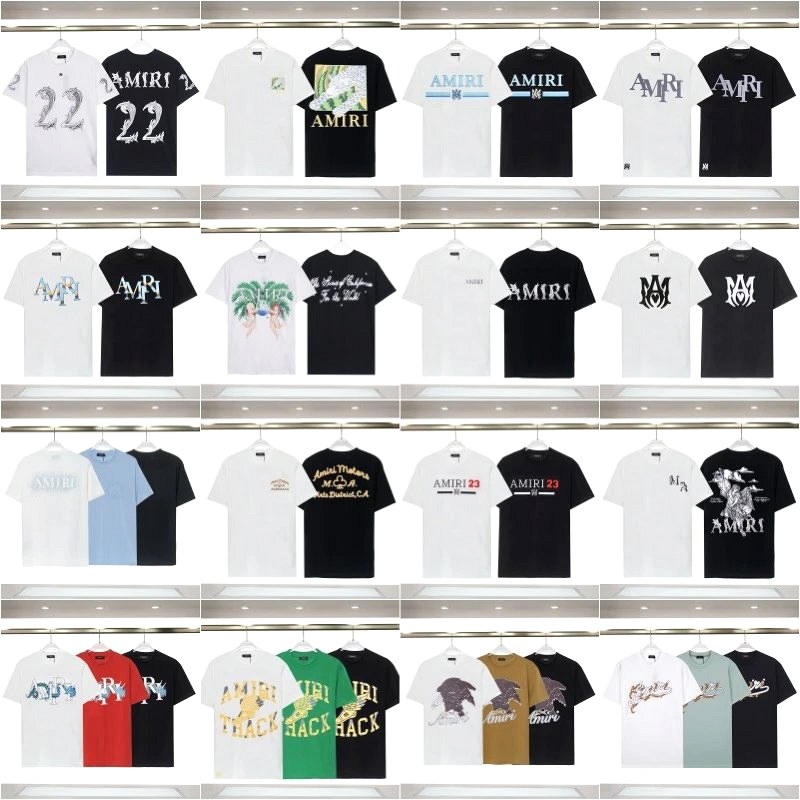
We ordered the Amiri letter-print logo T-shirt through Litbuy AI at $8.36 USD, down from a listed $9.87, under SKU 7715755319. It is a plain cotton crew neck with a graphic logo across the chest, sold in a very long colour run and sizes S to XXXL. Our testing team treated it as what it is: an inexpensive cotton tee whose entire value proposition rests on one printed panel, so the print — not the price — set the agenda for testing.
What the listing actually promises
The specification is thin but specific. We worked from these stated details and did not assume anything the seller left unsaid.
| Specification | Listing detail |
|---|---|
| Fabric | 100% cotton, plain weave |
| Stated weight band | 180–250 g/m² |
| Fit and construction | Loose cut, crew neck, short sleeves, pullover |
| Sizes | S, M, L, XL, XXL, XXXL |
| Dye-process logo and number graphics at the chest | |
| Colourways | Long run including black, white, red and blue variants |
| Stated measurement tolerance | 1–3 cm |
| Listing season | Spring 2025 |
| Price at review | $8.36 USD (was $9.87) |
| SKU | 7715755319 |
Fabric functions are described as breathable, wrinkle-resistant, moisture-wicking and colour-fast. Those are seller claims, not laboratory results, and we did not treat them as verified.
QC images before the parcel left the warehouse
Nothing ships until we have seen enough angles to judge the print. We ask for the front graphic shot square-on, a raking-light angle across the print surface, the inner neck label, the hem and sleeve stitching, and a full flat lay with a ruler. On this tee the square-on graphic shot is the one that matters most: it tells us whether the letter edges are clean or slightly bleeding into the cotton, and whether the printed area sits flat or has a visible ridge where the dye was applied. A missing raking angle is a rejection, because flat studio light hides exactly the surface texture we are checking.
Flat measurements against the seller's own chart
On arrival we laid the tee flat and measured chest width, shoulder seam to seam, body length from the high point of the shoulder, and sleeve opening, then compared each figure with the seller's chart for the size we ordered. Our sample landed inside the listed 1–3 cm tolerance against the chart numbers. That is the useful outcome here: it means the chart is usable as a buying guide for this listing, provided you read it per size rather than assuming the whole run scales predictably. Because the cut is deliberately loose, the chest figure is the one to pick from — two people with the same chest can reasonably order different sizes depending on whether they want the graphic hanging free or sitting closer to the body.
Fabric weight and behaviour on the body
We weighed the garment on a calibrated parcel scale on arrival. It sits at the heavier end of the listing's 180–250 g/m² band, which matches existing reporting that Amiri tees feel more substantial than a standard cotton tee. In practice that means a fabric with enough body to hold the loose cut rather than collapsing into it, and a surface that resists the light see-through you get with thin budget cotton in lighter colourways. We wore the tee indoors and outdoors across three sessions of two hours or more, logging creasing at the chest and under the arms and how quickly the fabric settled after being hung. Creasing appeared at normal folds and relaxed out overnight on a hanger; there was no pilling or surface fuzz after the wear sessions.
The print: our wash result and the documented risk
Apparel goes through two 30 °C washes before we write a second fit-and-finish note. After both cycles the print on our sample was intact — no lifting at the letter edges, no crazing across the fill, no colour transfer onto the adjacent cotton. That is a good early signal and nothing more. The print is the single most exposed component on a tee like this, and a short wash test says nothing about where it will be in a year.
Public reporting on Amiri tees gives us the longer view, and it is the reason we are not calling the print solved. One buyer who purchased from an authorised retailer reported the printed lettering cracking noticeably within roughly 18 months, despite limited wear, hanger storage and dry cleaning as instructed. That is one report, not a failure rate, and it concerns a retail garment rather than this listing. It is still the most relevant durability evidence available, and we weigh it accordingly.
The shade question we could not close
Colour verification failed, and we want to be blunt about why. The listing shows a wide palette and multiple graphic treatments, and QC threads show buyers disagreeing about how the printed logo should read in the first place.
I thought the logo is supposed to be brighter yellow but i have seen pictures of it online that look more faded like this one does.
That exchange is the whole problem in one line. If watchers with experience of the brand cannot agree whether a print should be bright or muted, then a normal buyer has no reliable reference to check against. We compared our sample against the listing photos under a neutral grey card in a light box and found the print reading within the range the listing shows, but "within the range" is a weak standard when reference images themselves conflict. Treat the shade as unverified.
Odour reporting and sizing in practice
One buyer reported a metallic smell developing after a few months of wear that survived washing. We found no odour on our sample out of the parcel or after two washes, but a single long-term report of this type is worth logging rather than dismissing — it is an unresolved signal, not a confirmed defect.
On size, the consistent guidance from buyers is that Amiri tops run slightly small, so sizing up is the common recommendation. Combined with a loose cut and a 1–3 cm tolerance, the safe move is to request a flat chest and length measurement in the exact size you intend to buy and match it to a tee you already own rather than to your body.
What remains unknown
There is no independent buyer feedback on this exact listing, and no test of this specific garment outside our own. Print adhesion beyond a few washes, colour accuracy across the dozens of colourways, and long-term fabric behaviour after many cycles are all open. Anyone buying here is accepting print risk in exchange for a low price and a genuinely varied colour range.