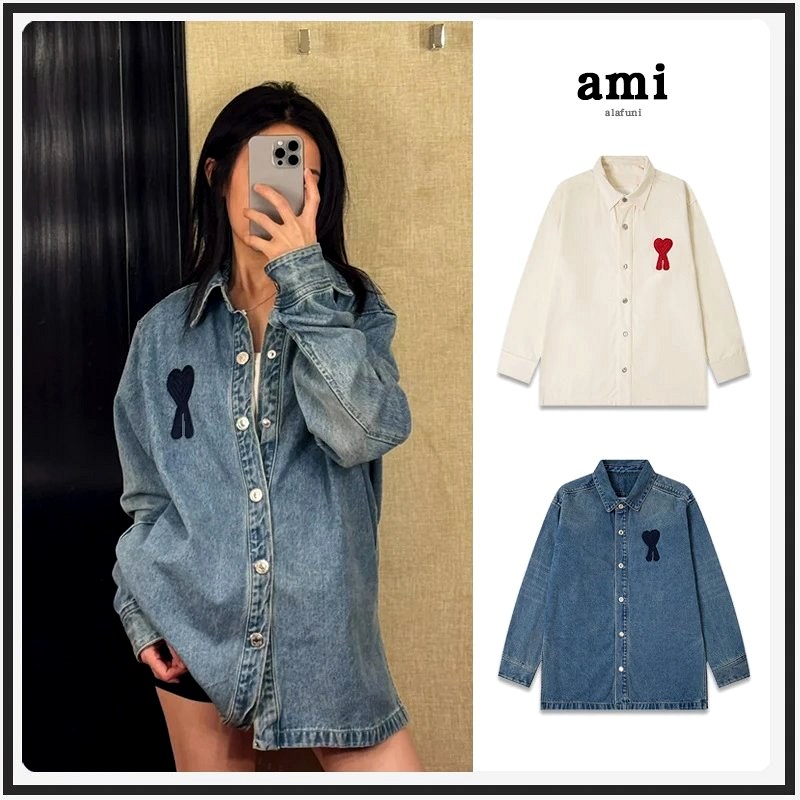
We ordered the Ami Paris heart-embroidered street-style denim jacket through Litbuy AI at $45.97, down from a listed $50.00, and it reached our Rotterdam desk sealed, with the QC set still attached to the order record. Retail Ami de Coeur denim jackets from brand stockists sit between roughly $500 and $740 depending on style ID, so on this route the sourcing model explains the gap, not the garment.
One listing that reads like two products
The page presents a denim jacket: blue wash, classic collar, button-front closure, a heart-shaped embroidered motif at the chest, plus a white version with red heart embroidery described alongside it. The automated specification block underneath does not agree. It names the fabric twice — cotton as the main fibre, cotton-linen as the fabric name — and its style fields describe a short-sleeve cardigan with a lapel collar, a press-free finish and a 1-3 mm error range. The generated search text still talks about a navy T-shirt from start to finish.
The variant tree explains the contradiction. Alongside dozens of jersey and knit codes, three entries are actual denim outerwear:
- 2266 — short denim jacket, offered in denim blue, apricot and apricot with a red heart
- 2268 — embossed denim jacket, in black, denim blue and apricot
- 2288 — unisex denim jacket, in denim blue, apricot and apricot with a red heart
Everything else in the tree — the 2202 to 2232 codes, including long-sleeve pocket-heart and short-sleeve black-heart versions — is a top, and the 2211 entries are a carbon-washed fabric option rather than a jacket. Because checkout on these listings follows the colour string rather than the silhouette, we asked the agent to confirm in writing which code sat behind our order before the parcel was forwarded. The confirmation came back on the unisex denim-jacket entry, and that code is what our retained photographs and measurements are logged against.
The QC set we request for a jacket
Our standard request is front and back flat, collar and closed placket, cuff and hem, a macro of the chest embroidery, the inner neck label and the care label. A missing angle triggers a re-request before anything ships, and on this order nothing had to be chased twice. The embroidery macro showed closed, evenly spaced satin stitching with no needle holes or wandering thread ends, and the heart motif sat square on the chest panel rather than skewed. Placket and hem topstitching ran straight, buttons engaged without play, and the inner label carried the expected product code rather than a blank tag.
One hardware note: brand-stockist descriptions of the Ami de Coeur truckers list a double metal zip, and our jacket is a button-front piece. That matches the source page's own description, so treat any zip reference in brand photography as a different style ID, not as a defect here.
Measured flat, then measured twice more
The listing declares a 1-3 mm error range but prints no absolute centimetre chart, so our readings are the only measured set tied to this order. We took every point twice on arrival and again after washing.
| Point (size L, flat) | Our reading | Note |
|---|---|---|
| Pit to pit | 58 cm | roughly 116 cm around the chest |
| Shoulder, seam to seam | 49 cm | seam sits close to the shoulder point, not well outside it |
| Body length, back collar to hem | 68 cm | moved about 0.5 cm after the second wash |
| Sleeve, shoulder seam to cuff | 62 cm | unchanged after washing |
| Hem width | 56 cm | straight hem, no elasticated waist |
Three of the five readings sat inside the declared 1-3 mm band on repeat measurement, which reads to us as consistent pattern-cutting rather than precision tailoring. Published brand figures exist for a related denim overshirt, but they cover a different style ID and a different measuring convention, so we did not use them as a benchmark.
Three wear sessions
- Session one, 2.5 hours indoors. Worn over a tee at desk temperature. The collar sat flat without chafing, the sleeves cleared the wrist bone, and the jacket never felt stiff enough to restrict reaching across a table.
- Session two, 2 hours outdoors. Light wind and drizzle in Rotterdam, worn closed. The cotton handled a short exposure without spotting; the fabric felt heavier and more structured damp than dry.
- Session three, 3 hours with a shoulder bag. The strap loaded the left shoulder and chest panel. No fading or abrasion appeared where the strap crossed, and the buttons stayed engaged through repeated opening.
Our wear log: hard creases formed across the inner elbows by the end of the second session and relaxed again on the hanger; a light bulge appeared behind the placket buttons; no seam slippage, loose threads or cuff wear after roughly 7.5 hours of wear.
Two 30 °C washes
Washed inside out on a gentle 30 °C cycle and line dried, twice, per our apparel routine. The first wash released noticeable blue into the water; the second released far less, and no panel fading or patchiness appeared afterwards. The chest embroidery came out unchanged, with no lifting at the motif edges. Shrinkage was small but real: body length and pit-to-pit each moved about half a centimetre on our tape — the kind of shift published buyer guidance for cotton Ami heart pieces predicts even with cold washing and flat drying.
Community guidance for these cotton pieces warns that high-heat tumble drying deforms the heart motif and shrinks the garment, which is why we line dried both times.
Fit advice that does not transfer to this jacket
The clearest sizing line in circulation is the brand's own for the Ami de Coeur T-shirt — unisex, men take their usual size, women take one size down — and community guidance for those tees about shoulder seams landing 2-3 cm outside the shoulder point. Both describe knitwear. Brand stockists describe the related denim overshirt as oversized, and this listing declares a loose fit. On our tape the jacket sat relaxed without pulling across the back, and the shoulder seam landed near the shoulder point rather than well outside it.
What we still cannot confirm
- Which fabric actually sits behind our code: the page states cotton and cotton-linen in the same block.
- Whether the white version with the red heart embroidery is cut identically to the blue wash we received.
- The seller's absolute centimetre chart, since only a tolerance figure is published.
- Any independent buyer report for this specific listing — we found none, and the nearest peer reports concern Ami tops, not this jacket.
Prices on agent routes move with the underlying listing data, so the figure we paid is the figure attached to our order record rather than a standing reference. Re-check it, and the variant code, before checkout.